

The shorter stay isn’t always the simpler choice. In the short term rental vs corporate housing decision, stay length is a useful starting point: short-term rentals commonly cover days to 2-3 weeks, while corporate housing is furnished accommodation for professionals staying a month or longer, often for one to six months. A shorter booking tends to suit a brief visit, while corporate housing is designed for a longer work-related stay.
Both options can provide a comfortable base away from home. The key difference is how well each fits your schedule, work needs and preferred routine.
This guide explains corporate housing in Australia and how it compares with short-term rentals and longer leases. It also covers practical factors to weigh when choosing business accommodation, from assignment length to the space and flexibility you need.
Key Takeaways
- Corporate housing is furnished accommodation for professionals staying a month or longer, while short-term rentals suit briefer visits.
- Match the stay type to your schedule: short-term rentals commonly cover days to 2-3 weeks, corporate housing often lasts one to six months, and traditional leases usually run 12 months or longer.
- For business travel, weigh the assignment length, work needs and potential for extensions when choosing between a hotel, furnished rental or corporate housing.
- For a Canberra stay, consider options such as Capitol Apartments in Canberra City, Peaceful Coombs Apartment for Families, and Luxury Apartment in Braddon Precinct.
What is Corporate Housing?
The short term rental vs corporate housing decision often comes down to the length of your stay and the routine you need. Corporate housing is furnished accommodation for professionals on temporary work assignments, while short-term rentals generally suit briefer visits.
Furnished temporary accommodation
Corporate housing is furnished residential accommodation for a temporary, work-related stay. In Australia, stays are typically a month or longer and often last one to six months. A fully furnished apartment lets travelling professionals settle in without bringing household essentials. It can suit a project or temporary assignment when a room designed for a few nights does not support everyday living.
Furnishings, amenities and utilities
Corporate housing typically combines household furnishings with amenities for work and daily life. An apartment may include a kitchen, living area, workspace, utilities and Wi-Fi. High-speed internet can support video calls and online tasks. These inclusions matter during an extended stay: a kitchen makes everyday meals easier, while a separate work area can help distinguish work time from downtime. Check the booking terms to see what is included.
Corporate housing and other furnished stays
Corporate housing, serviced apartments and furnished rentals can all provide a ready-to-use place to stay, but their booking arrangements and inclusions differ. Corporate housing is commonly arranged for extended work stays. A serviced apartment may suit a shorter visit where service arrangements are part of the accommodation. A furnished rental offers residential space, though it may not be set up specifically for work assignments. The short term rental vs corporate housing comparison is most useful when you consider the trip’s length and your daily routine.
Prices vary by location, property type, stay length and inclusions. Corporate housing may be priced monthly, while short stays are often priced by night.
Tenancy, consumer and accommodation rules vary across Australian states and councils. The relevant terms depend on the location and booking arrangement.
Review the deposit, cancellation and damage terms before booking. Check how your travel insurance treats belongings during the stay.
Typical stay durations for short-, mid- and long-term rentals
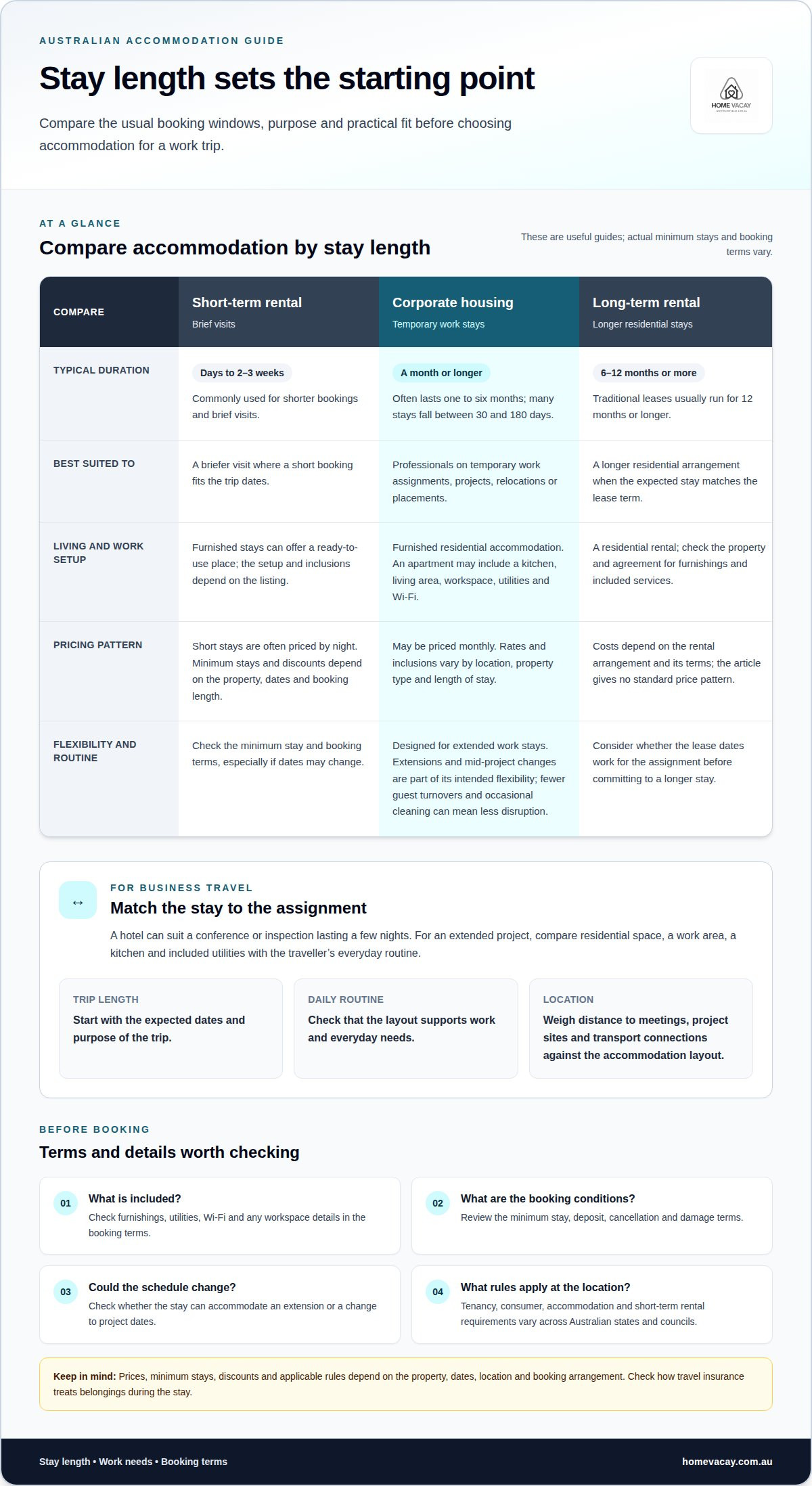
Stay length helps distinguish a short booking from a temporary work arrangement or residential lease. These categories are useful guides, but the actual minimum stay and booking terms matter too.
Typical stay durations
Short-term rentals commonly cover days to 2-3 weeks. Mid-term stays bridge the gap, while corporate housing often suits assignments lasting one to six months. Long-term rentals typically run for 6-12 months or more, and traditional leases usually last 12 months or longer. For employees, matching the booking to the project timeline can reduce unnecessary moves and support comfort, convenience and flexible arrangements.
Minimum stays and extended-stay discounts
Minimum stays and discounts depend on the property, dates and booking length. Some short-term listings accept brief visits, while others set a longer minimum. Corporate housing commonly lasts 30 days or more, and many stays fall between 30 and 180 days. Pricing may be reduced by 10-15% for stays of 14-29 days. Companies may seek 20-30% off corporate rentals during the off-season. These are market patterns, not guaranteed terms. A longer booking makes sense only if its dates suit the assignment and the accommodation meets the traveller’s needs, such as a separate bedroom or work area.
State and council restrictions or registration requirements for short-term rentals vary across Australia. Applicable conditions depend on the location and accommodation arrangement.
Tax and GST treatment can also depend on the rental arrangement and the parties involved. The stay category alone does not determine the outcome.
For a furnished short stay, explore accommodation options with Home Vacay and choose dates that suit your plans.
Choosing accommodation for business travel
For business travel, match accommodation to the assignment, daily routine and possibility of schedule changes. A hotel can suit a conference or inspection lasting a few nights, while a longer project may call for a more residential arrangement.
Corporate housing for businesses
Corporate housing gives businesses furnished accommodation for employees on temporary work assignments. It can provide a consistent base for a project, relocation or placement, rather than requiring repeated short bookings. Employers typically pay the rent and associated costs, making accommodation part of the work travel arrangements. For example, an employee away on a project may value a kitchen and living area for everyday routines, along with a suitable place to work.
Stays for extended business travel
Corporate housing is designed for extended work stays and can accommodate changes to project plans. Extensions and mid-project changes are part of its intended flexibility, which can help when work dates shift or an employee needs to stay in the same place. Compared with short-term rentals, corporate housing generally involves fewer guest turnovers and occasional cleaning, which can mean less disruption during a longer assignment.
Start with the expected trip length and purpose. For a brief conference, inspection or stay of a few nights, a hotel may be practical. For an extended assignment, compare the living space, work area, kitchen and included utilities with the traveller’s routine. The right fit supports work and everyday needs without adding avoidable moves or complicated travel arrangements.
Location matters too. Consider the distance to meetings, project sites and transport connections, then weigh travel time against the accommodation’s layout. A central base may suit a schedule of meetings across a city, while a quieter location may work better for a project outside the centre. Let the destination and work pattern guide your choice.
Short-term rentals may involve frequent check-ins, cleaning and guest turnover. Corporate housing generally has fewer turnovers and occasional cleaning. Businesses can factor these differences into travel planning, especially when several employees need accommodation or an assignment may change. Before booking, consider how an extension could affect dates and routines.
Australian corporate housing providers
Australian accommodation options range from specialist corporate housing to short-stay operators with furnished apartments. The right fit depends on the assignment, location and length of stay.
To find and book corporate housing or a short-term rental in Australia, first set the destination, dates and expected stay length. Then compare accommodation type, inclusions and booking terms with the traveller’s needs.
Corporate housing providers focus on temporary work stays, including employee assignments and relocations. Accommodation may include a fully equipped kitchen, living space, workspace, utilities and internet, supporting day-to-day routines during a longer placement. Short-stay operators can also offer furnished accommodation, but their booking arrangements may better suit shorter visits.
Hotels are another option for brief business trips. They can suit a conference or inspection where the traveller needs a place for a few nights. For an extended assignment, a furnished apartment may provide more residential space, such as a kitchen and separate living area. Compare what each booking includes rather than relying on the accommodation label alone.
Before booking, match the dates to the project timeline and consider whether you might need an extension. Review the full booking terms, including utilities, cleaning arrangements, cancellation conditions and any minimum stay. For a team, consistent accommodation arrangements can also simplify travel planning. These details help businesses choose a practical option without assuming every property offers the same setup.
Some corporate housing providers hold the Certified Corporate Housing Professional credential or participate in a company accreditation program. Credentials can be one point of comparison, alongside the property’s location, furnishings and suitability for the assignment. They do not replace reviewing the accommodation itself and its booking terms.
For a flexible furnished stay nationwide, explore short-stay accommodation options tailored for business or leisure travel with Home Vacay.
Home Vacay
Home Vacay offers short-term accommodation for business and leisure stays. If your plans call for a furnished place in Canberra, its options include Capitol Apartments in Canberra City, Peaceful Coombs Apartment for Families and Luxury Apartment in Braddon Precinct.
These stays may suit a shorter work trip or family visit where a residential-style apartment fits better than a brief hotel stop. The right choice depends on your dates, destination and length of stay. For an assignment requiring a longer corporate housing arrangement or a residential lease, short-term accommodation may not be the right fit.
If a Canberra short stay suits your plans, contact Home Vacay to discuss your accommodation.
Choose accommodation around the trip ahead
Before booking, turn your travel plan into a short accommodation brief. Note the purpose of the stay, likely arrival and departure dates, who is travelling and what a normal workday involves. This gives you a clearer basis for weighing the short term rental vs corporate housing choice, especially if the assignment dates could shift.
Think beyond the booking itself. The right fit should support the traveller’s routine from arrival through the final workday while meeting the trip’s practical needs. If the plan changes, reassess the length and type of stay rather than assuming the original arrangement still works.
For a Canberra stay, Home Vacay has apartment options for business and leisure travel. Contact Home Vacay to discuss accommodation for your plans. With a clear brief and a little forward planning, you can make your next stay feel more settled.
Frequently Asked Questions
What are Short-Term Rentals?
A short-term rental is accommodation booked for a temporary visit rather than an ongoing home. It may be a private apartment or house, booked for the dates a guest needs. For example, a traveller attending a conference can book a place for the trip and leave at the agreed end date. The listing and booking terms explain what the stay includes.
What is typically included in corporate housing versus a short-term rental?
Corporate housing is generally arranged as a ready-to-live-in home for a work assignment, while short-term rentals can vary from listing to listing. For either option, compare details that affect daily life, such as cooking equipment, workspace, internet access and utility arrangements. A traveller working remotely, for example, may need a suitable desk and reliable internet more than someone spending most days in meetings.
What are the minimum and maximum booking periods for corporate housing and short-term rentals in Australia?
Short-term rental bookings can cover a few days, while corporate housing typically starts at 30 days or more. There is no single maximum booking period that applies across every Australian property and arrangement. The permitted length depends on the accommodation’s booking terms. A work assignment with changing dates may need a different arrangement from a fixed holiday, so consider the likely end date before booking.
Which option is better for a business trip, relocation or temporary work assignment?
A short-term rental can suit a brief business trip with fixed dates. Corporate housing is often a better match for a temporary assignment that needs a settled base or may last longer than planned. For relocation, the right choice depends on how long the transition takes and whether the stay is temporary. Match the booking to the work schedule, household needs and likelihood of an extension.
How do short-term rental and corporate housing prices compare in Australian cities?
Prices vary by location, property type, stay length and inclusions. The material gives no comparable rates for other Australian cities.
What insurance, security deposit and cancellation risks should guests consider?
Review the deposit, cancellation and damage terms before booking, and check how your travel insurance treats belongings during the stay.


