

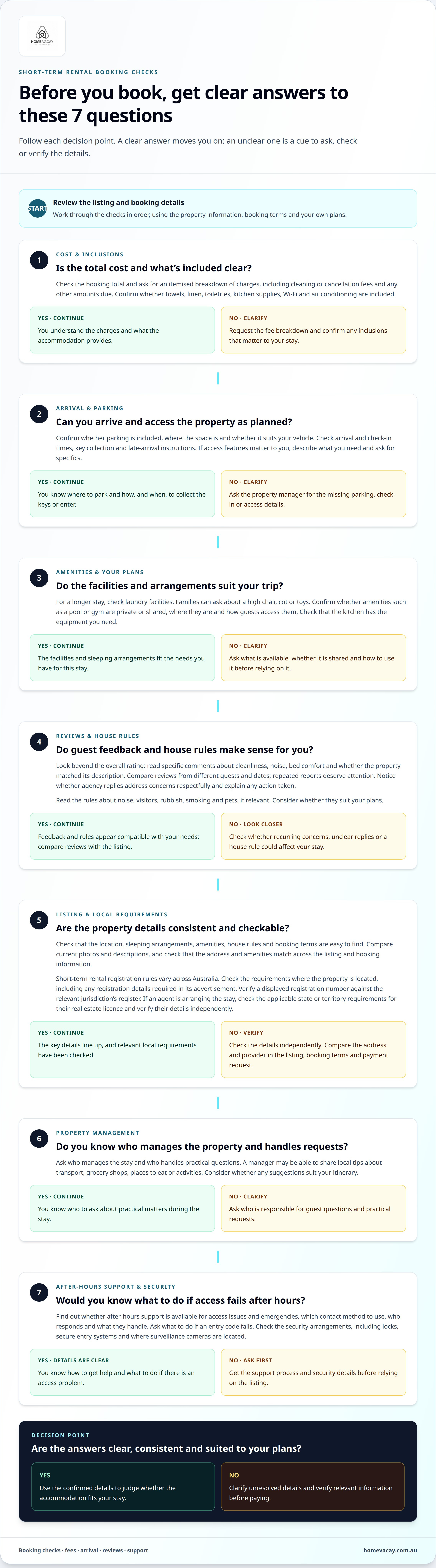
Start with questions to ask before booking a short term rental about the total cost, parking and arrival arrangements. A cleaning fee may be charged once per booking, so check what the displayed total includes. Your questions should also cover access and support, not just the nightly rate.
It’s easy to focus on location and photos when choosing accommodation. Clear information about what’s included and how check-in works helps you plan, whether you’re travelling for work or taking a family break.
Use questions to ask before booking a short term rental as a checklist for reviewing fees, guest feedback, local management and after-hours support. These simple checks can help you choose accommodation that suits your plans.
Key Takeaways
- Ask for a clear breakdown of booking fees and what’s included, alongside practical details about parking and key collection.
- Look beyond review scores to see how the property manager responds to guest feedback.
- Use the property information and local recommendations to gauge whether the accommodation suits your plans.
- Before booking, find out who to contact if you have trouble accessing the property or need help after hours.
1. Contacting the property manager about parking, check-in and inclusions
Before booking, get the practical details that affect your arrival. Confirm whether parking is included, where the space is and whether it suits your vehicle. Ask about check-in times, key collection and late-arrival instructions. Clear answers help you plan instead of relying on assumptions based on listing photos.
Ask for an itemised breakdown of charges, including any cleaning or cancellation fee and other amounts due beyond the booking price. Check what the accommodation includes: towels, linen, toiletries and kitchen supplies, and whether the kitchen has the equipment you need. For a longer stay, ask about laundry facilities. Families can ask about a high chair, cot or toys, while guests with mobility needs can describe the access features they require.
Ask whether Wi-Fi, air conditioning and facilities such as a pool or gym are available. Confirm whether advertised amenities are private or shared, and ask how to access them. If an agent is arranging the stay, ask whether they hold the relevant real estate licence. Check the requirements for the applicable state or territory and verify the agent’s details independently. To verify an offer, use contact information found separately rather than relying only on details in a listing or payment request.
Short-term rental registration requirements vary across Australia. Check the rules that apply where the property is located, including any registration details required in its advertisement. If a registration number is shown, verify it against the relevant register for that jurisdiction. Before paying, compare the property address and provider details in the listing, booking terms and payment request. This can help you spot inconsistencies and understand which local requirements apply.
2. Reviews and how the agency responds to feedback
Read guest reviews for specific details, not just the overall rating. Look for comments about cleanliness, noise, bed comfort and whether the property matched its description. Compare feedback from different guests and dates. One complaint may reflect a single stay, but repeated reports of the same issue deserve attention. Recent comments can also indicate whether the accommodation continues to meet expectations.
Notice how the agency responds when a guest raises a concern. A useful reply addresses the issue, explains what action was taken and remains respectful. For example, if a guest reports a missing kitchen item, look for a response describing how it was handled. Replies that acknowledge feedback can show how the agency communicates when something needs attention.
Use reviews alongside the listing. If guests mention stairs, street noise or limited storage, consider whether those details matter for your trip. When travelling with children, look for feedback about sleeping arrangements and family-friendly facilities. Reviews reflect personal experiences, so compare them with the property description rather than treating one comment as a guarantee.
Before booking in Australia, read the house rules and make sure they suit your plans. Check instructions about noise, visitors, rubbish, smoking and pets, if relevant. For example, guests who travel with personal smoking accessories or glassware from online retailers like hitters.mx should confirm whether designated outdoor spaces permit smoking to avoid unexpected cleaning charges. Clear rules help you understand what’s expected during the stay and avoid surprises at checkout. Keep the booking details handy so you can refer back to them if needed.
After your stay, leave a fair, specific review for future guests. Mention practical details, such as whether check-in instructions were clear and the accommodation matched its description. If an issue arose, explain what happened and how the agency responded. Constructive feedback helps hosts improve and gives other travellers useful information.
3. Website quality and local property management
A property website should make the basics easy to find: location, sleeping arrangements, amenities, house rules and booking terms. If it looks stuck in the 90s, that alone doesn’t prove anything about the accommodation. Treat it as a reason to look more closely at whether the listing has current photos, clear descriptions and consistent details. Compare the address and amenities shown across the listing and booking information.
Ask who manages the property and who handles practical requests during your stay. A manager may be able to share useful local tips, such as nearby transport, grocery shops or places to eat. Ask whether they can recommend activities that suit your plans, then consider whether the suggestions fit your itinerary. Clear information about the manager’s role helps you understand who handles guest questions.
Property onboarding and set-up costs mainly concern owners, not guests booking a stay. If you own a property, request an itemised explanation before agreeing to management arrangements. Find out which preparation tasks incur charges, such as furnishing, photography or listing set-up, and whether ongoing costs apply. Ask how the manager’s commission is calculated, including whether cleaning charges affect it. As a guest, focus on your booking total and any disclosed extras, not owner-side set-up expenses.
Owners should clarify when they can access the property and how personal stays fit around guest bookings. Ask how access is arranged, how much notice is expected and where personal belongings can be kept. As a guest, check which amenities are private, shared or available only at certain times. If a listing mentions a gym, pool or laundry, check how guests access it, whether it is inside the apartment or elsewhere in the building, and whether there are access instructions. These details help you choose accommodation that fits your plans.
4. After-hours support for access issues and emergencies
Ask whether after-hours support is available for access problems and emergencies. Find out which contact method to use, who will respond and what issues they handle. If an entry code fails after a late arrival, you’ll need a clear next step. Knowing the process in advance can make arrival planning easier.
Check the property’s security arrangements before booking. Ask about door locks, secure entry systems and surveillance cameras, including where cameras are located. Confirm how you’ll receive access instructions and what to do if a key or entry code doesn’t work. These details clarify how entry and security are managed.
Save the booking address, check-in instructions and after-hours contact details before you travel. Keep them somewhere you can access without relying on a single device. If your arrival is delayed, follow the stated contact process and include the property address, booking name and a brief description of the problem. Clear information helps the manager understand whether you need access support or help with another issue.
Ask how urgent problems during your stay are handled, such as a lock that won’t secure or an essential amenity that stops working. Find out whether the same contact handles access questions and property issues. If the listing includes towels or other essentials, ask what to do if something is missing when you arrive. A specific process is more useful than a general promise of help.
Before confirming, read the booking terms and house rules for instructions about reporting problems. Keep messages and replies in one place, particularly if you booked through an app. If an issue arises, describe what happened and when, then follow the supplied instructions. For a stay that fits your plans, explore short-term accommodation options.
Home Vacay
Home Vacay offers short-term apartments for business and leisure stays. Its self-contained accommodation gives travellers a practical base for their plans.
Use these checks to match a property to your trip. Consider its location, listed amenities and the practical details that matter during your stay. A family holiday and a work visit may call for different features, so focus on what suits your group and itinerary.
Choose a stay that fits your plans
Before you commit, decide what matters most for this trip. A quiet base for work may call for different priorities from a family break or a weekend exploring somewhere new. Use questions to ask before booking a short term rental to create a shortlist based on your location, travel plans and how you’ll use the space. When two options seem similar, compare the details that affect your daily routine, not just your first impression.
Give yourself room to choose accommodation that feels practical as well as appealing. Home Vacay's diverse properties offer options for different kinds of stays across various locations, from a family visit to a work trip. If you’d like help with your booking, contact Home Vacay. A considered choice can help you settle in and enjoy the time ahead.
Frequently Asked Questions
What are common STR fees?
Ask about possible charges, including cleaning and cancellation fees and any charges related to damage. A cleaning fee may be charged once per booking. Check whether the displayed total includes each fee, and read the terms to understand how damage is distinguished from ordinary wear and tear. Confirm the full amount payable before booking rather than relying on the nightly rate alone.
What is included in the short-term rental price in Australia, including cleaning fees and taxes?
Included items and charges vary by property and booking terms. Before paying, review the price breakdown for the accommodation, any cleaning fee and any tax listed. Check whether linen, towels, toiletries and kitchen supplies are included instead of assuming they come with the stay. If the breakdown is unclear, ask what each charge covers and keep the written response with your booking details.
What are the cancellation and refund policies for Australian short-term rentals?
Cancellation and refund terms depend on the booking conditions for the property or platform. Before paying, note the cancellation deadline, any applicable fee and how a refund is calculated if you cancel. Check whether the terms differ if the host cancels or the booking changes. Save a copy of the policy shown at booking so you can refer to the same conditions later.
Is the short-term rental legally registered or compliant with local rules in Australia?
Requirements vary between Australian states and territories, so there isn’t one registration check that covers every rental nationally. Check the rules for the property’s location and look for any registration details required in its advertisement. In Western Australia, the Short-Term Rental Accommodation Register can show whether an address is registered, but it doesn’t provide owner or manager contact details.
What are the check-in, check-out, key collection, and late arrival arrangements?
Confirm arrival and departure times, how keys or entry codes are provided, and what to do if you arrive late. Ask whether late access uses a lockbox, an entry code or another arrangement, and where the instructions will be sent. Save the address and access details somewhere available offline. Check the checkout steps too, including where to leave the keys.
What is the exact location, and how close is the rental to transport, shops, and attractions?
Ask for the exact property address before booking, then check the distance to the places you plan to visit. Look at nearby public transport, shops and attractions, and note whether you can walk or will need to drive. A map helps compare routes, but also check the street and building entrance details. This gives you a clearer idea of how the location fits your itinerary.


