

A polished listing isn’t proof that a short-term rental is properly registered or accurately described. In New South Wales, short-term rental accommodation properties must be registered. In Western Australia, listings must display their STRA registration number, which guests can check against the public register. Knowing how to verify a short term rental listing means checking the relevant registration details and comparing the advertising with what the property actually offers.
Look beyond attractive photos before you book. Registration and permit requirements vary across Australia, so the right checks depend on the property’s location. This guide explains how to look up a listing’s registration, understand local permit requirements and spot potentially misleading advertising. These steps can help you assess a place before making plans.
Key Takeaways
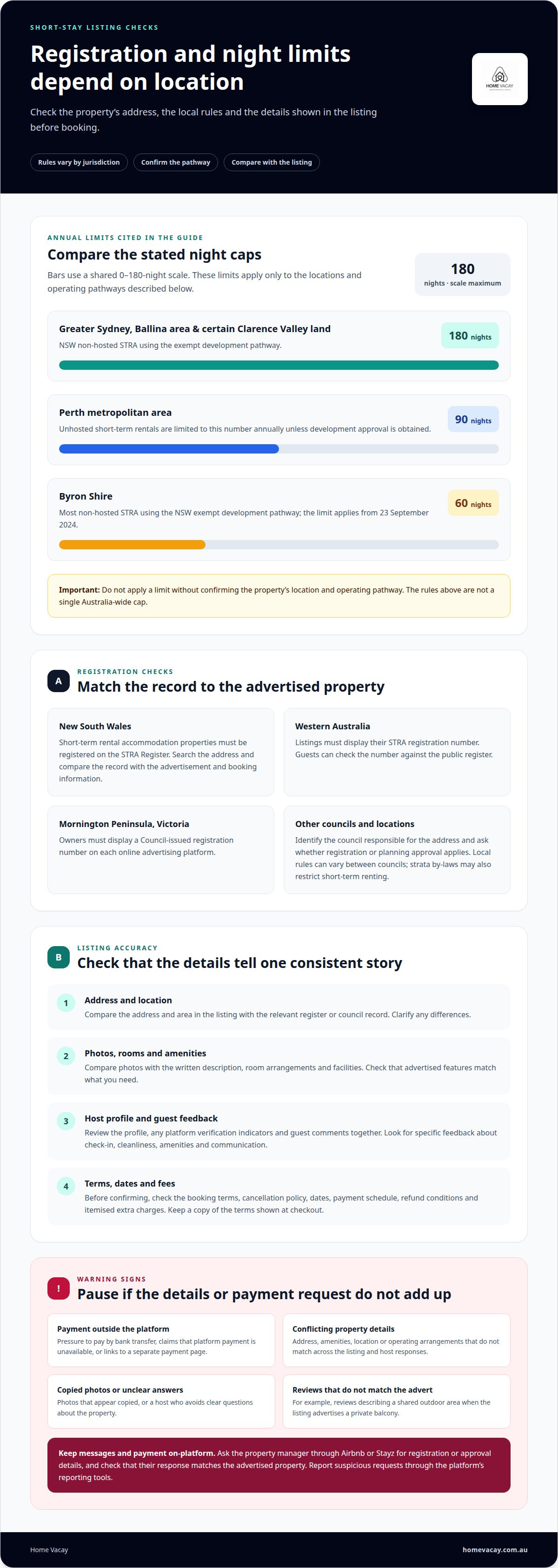
- Match the property’s registration details to the rules for its location. In Perth’s metropolitan area, the Government of Western Australia limits unhosted short-term rentals to 90 nights per year unless development approval is obtained.
- Compare the listing’s photos, amenities and location details with the stay you’re booking. Clear, consistent descriptions help you understand what to expect.
- Review the host profile and guest feedback on the booking platform, and watch for details that seem inconsistent or pressure to arrange payment outside the platform.
- Use the checks in this guide to assess permits, advertising and potential warning signs before booking a short-term stay.
Verifying existing listings and permits
To verify a short term rental listing, start with its address and location. Registration records show whether accommodation appears on the relevant register. In NSW, all short-term rental accommodation properties must be registered on the STRA Register. Search the property address, then compare the record with the advertisement and booking information.
Development approval is permission for a property to operate as short-term accommodation where required. According to the Government of Western Australia, unhosted short-term rentals in Perth’s metropolitan area are limited to 90 nights annually unless development approval is obtained. Check whether the listing’s stated operating arrangements match the applicable local requirements.
In NSW, the NSW Department of Planning, Housing and Infrastructure limits non-hosted STRA using the exempt development pathway to 180 days annually in Greater Sydney, the Ballina area and certain land in the Clarence Valley area. From 23 September 2024, the department limits most non-hosted STRA using that pathway in Byron Shire to 60 days a year. Confirm the property’s location and pathway before applying either limit.
Rules differ between Australian jurisdictions. Local councils set short-term rental requirements in Western Australia, and rules can vary between councils. On the Mornington Peninsula in Victoria, owners must display a Council-issued registration number on each online advertising platform. In Queensland or elsewhere, identify the council responsible for the address and ask whether registration or planning approval applies. Strata by-laws may also restrict short-term renting.
A practical way to verify a short term rental listing is to compare its address and registration details with the relevant register or council record. Contact the property manager through Airbnb or Stayz to request the registration number or approval details, then check that the response matches the advertised property. Keep the discussion on-platform before booking, and clarify any differences in the address or operating arrangements.
Accurate and honest rental advertising
Accurate advertising should give guests a true overall impression of the accommodation. Compare the listing details with the terms shown before booking.
Host identity and guest reviews
A host profile identifies the person or business responsible for a listing. On Airbnb or Stayz, review the profile, platform verification indicators and guest comments together. Check that details such as location and amenities are consistent across the profile and property description. Read recent comments for specific experiences, including check-in and cleanliness. A polished profile alone doesn’t establish that every advertised detail is accurate, so keep questions and booking on the platform.
Scam warning signs
A rental scam misrepresents accommodation or steers guests into a risky payment or booking arrangement. Be cautious if someone pressures you to pay by bank transfer outside Airbnb or Stayz, claims the platform’s payment system is unavailable, or sends a link to a separate payment page. Other warning signs include copied photos, conflicting property details and a host who avoids clear questions. Keep messages on the booking platform and report suspicious requests through its reporting tools.
In Australia, rental advertising should accurately describe the property and create a true overall impression. Compare each photo with the written description: “private parking space”, for example, should not mean uncertain street parking. Check the address area, room arrangements, facilities and any stated limits against your needs. Save the listing and booking terms so you can refer to the advertised details later.
For safer payment, book and pay through Airbnb or Stayz’s official process rather than transferring money directly to a host. Don’t follow payment links sent outside the platform.
Before confirming, read the contract or booking terms, cancellation policy and itemised fees. Check the dates, accommodation details, payment schedule, refund conditions and any extra charges, then keep a copy of the terms shown at checkout.
When planning your next trip, explore trusted short-stay accommodation options through Home Vacay that suit your travel needs.
How can I verify a host's identity and reviews on Airbnb or Stayz?
A host identity is the profile information attached to an Airbnb or Stayz listing. Open the host profile from the accommodation page and check whether the name, photo and description appear consistent. Look for any identity verification indicator displayed by the platform, but treat it as one detail rather than proof that the host owns or manages the property. A profile can help you assess who you’re communicating with, but it doesn’t confirm every listing claim.
Guest reviews are comments from people who report staying at the property. Read reviews on the platform, not just testimonials copied into the listing description. Look for specific comments about check-in, cleanliness, amenities and communication. A review describing a smooth arrival or a missing kitchen appliance gives more useful context than a general compliment. Check whether several reviewers mention the same strength or concern.
Use these steps on Airbnb or Stayz before booking:
- Open the host profile directly from the listing, then compare its details with the property description.
- Read positive and critical reviews, including comments about the features you need.
- Check whether review details match the advertised facilities, location and check-in arrangements.
- Message the host through the platform about specific uncertainties, such as parking or access.
Consistency matters. If a listing advertises a private balcony but reviews repeatedly describe a shared outdoor area, ask for clarification through Airbnb or Stayz. Compare the host’s reply with the listing rather than relying on a verbal assurance. Keep the conversation on-platform so the booking details and response remain together.
Review patterns, not just the overall rating. Detailed feedback about a property’s actual facilities offers more context than brief, repeated praise. Consider how relevant each comment is to your stay. A family may prioritise sleeping arrangements, while a business traveller may focus on internet access and a quiet workspace. Use the profile, reviews and direct platform messages together to make a considered decision.
What are common short-term rental scams in Australia and their warning signs?
A short-term rental scam uses a misleading listing, false identity or dishonest booking process to obtain money or personal details. Recognising the approach can help you pause before paying or sharing information. A convincing photo alone doesn’t prove that the advertised property is available or controlled by the person offering it.
A duplicate listing copies genuine property details to advertise accommodation the scammer doesn’t control. Search distinctive phrases from the description and compare photos, location and host details across results. Be cautious if the same images appear with different addresses or contact details. Ask the host a specific question about a feature shown, such as the view from the balcony, and compare the answer with the listing.
A bait-and-switch listing offers one property, then directs the guest to another after booking. Look for changes to the address, room arrangement or facilities in messages and payment requests. Moving communication away from Airbnb or Stayz can make the change harder to document. Keep the booking conversation on-platform, and don’t agree to substitute accommodation without reviewing the revised terms.
A phishing message imitates a booking platform to collect login or payment details. Avoid signing in through a link in an unexpected text or email. Open the Airbnb or Stayz app directly and check for matching messages there. Never share a password or one-time security code with a host. If a message claims there’s an urgent account problem, use the platform’s own help function instead.
Before paying, match the recipient, property details and total shown at checkout with the listing. Treat pressure to act immediately, unexplained payment changes or reluctance to answer clear questions as reasons to stop. Save the listing, messages and booking confirmation. If something appears suspicious, report it through the platform and contact your bank promptly if you’ve shared payment details.
For a straightforward stay, explore short-stay accommodation options suited to your plans.
Home Vacay
Home Vacay offers short-term apartments for business and leisure stays, giving you a place to consider once you’ve assessed a listing’s details. In Canberra, options include Capitol Apartments in Canberra City, Peaceful Coombs Apartment for Families and Luxury Apartment in Braddon Precinct.
These stays may suit you if your plans call for an apartment in Canberra rather than a listing you’re still unsure about. Consider the location and the type of stay you need, then review the relevant property information as part of your booking decision. The checks in this guide can help you make a more informed choice across short-term accommodation.
For information about a Canberra stay, contact Home Vacay.
Choose a stay that fits your plans
Your next step is to choose a stay that suits the way you’ll travel. Think about what matters most: a convenient base for work, room for a family or a comfortable place to unwind. Let those priorities guide your choice rather than relying on polished photos or a long list of amenities.
Knowing how to verify a short term rental listing gives you a sounder basis for choosing accommodation. Review the details that matter to your stay, and keep your booking information together for easy reference. If Canberra is on your itinerary, explore Home Vacay’s options for business and leisure travellers.
For help choosing a Canberra stay, contact Home Vacay. A thoughtful choice can make planning feel simpler and leave more room to enjoy the trip ahead.
Frequently Asked Questions
How can I verify a short-term rental listing is legitimate in Australia?
Check that the listing, booking confirmation and payment record all refer to the same accommodation and host. Keep the reservation within the booking platform, and read the final confirmation before paying or travelling. If the confirmed property differs from the original listing, pause and ask the platform to clarify the change. Save relevant messages and receipts so the agreed booking details are easy to retrieve.
How do I check whether a holiday rental address and photos are genuine?
Compare the address and photos with publicly visible map imagery and nearby landmarks. A distinctive building entrance, street view or outlook can help you assess whether the images fit the advertised location. You can also search a distinctive photo or phrase from the description to see whether it appears with different property details. Treat mismatches as a reason to ask the host for clarification through the booking platform.
How can I check whether a short-term rental is registered or approved in my Australian state or territory?
Start with the property’s local council, because requirements depend on location and may involve registration, planning approval or both. Search the relevant state or territory register where one applies, then compare its property details with the listing. If the register doesn’t clarify whether planning approval is required, ask the council about that address specifically. Also consider whether strata by-laws affect short-term renting in the building.


