

A security deposit is a temporary safeguard, not an extra charge. Understanding security deposits for holiday rentals means knowing that money is held before a stay and may be used for valid claims, such as guest-caused damage or excessive cleaning. If there is no damage or other claim under the agreement, the deposit should be refunded or the card hold released after checkout.
It is reasonable to protect a property without leaving guests unsure about possible charges. There is no single deposit amount that suits every holiday rental. The right amount depends on factors such as the contents’ value, the length of the stay and the property’s risk profile.
This article explains what a deposit can cover, when a deduction may be justified and how to distinguish damage from normal wear and tear. It also outlines the agreement terms that help set clear expectations before guests arrive.
Key Takeaways
- Document the property’s condition before and after each stay so any damage claim has clear supporting evidence.
- Set a deposit that reflects the property, its contents and the stay, rather than applying one amount to every booking.
- Put the deposit amount, how it is held, release timing and possible deductions in the agreement and booking information.
- Separate a refundable security deposit from a booking payment, and distinguish guest-caused damage from ordinary wear and tear.
What are my rights to charge guests for the damage they cause?
Hosts may seek payment for guest-caused damage or agreed extra cleaning when the terms are clear and the claim is supported by evidence. Understanding security deposits for holiday rentals helps set fair expectations about potential claims.
Deposit and protection options
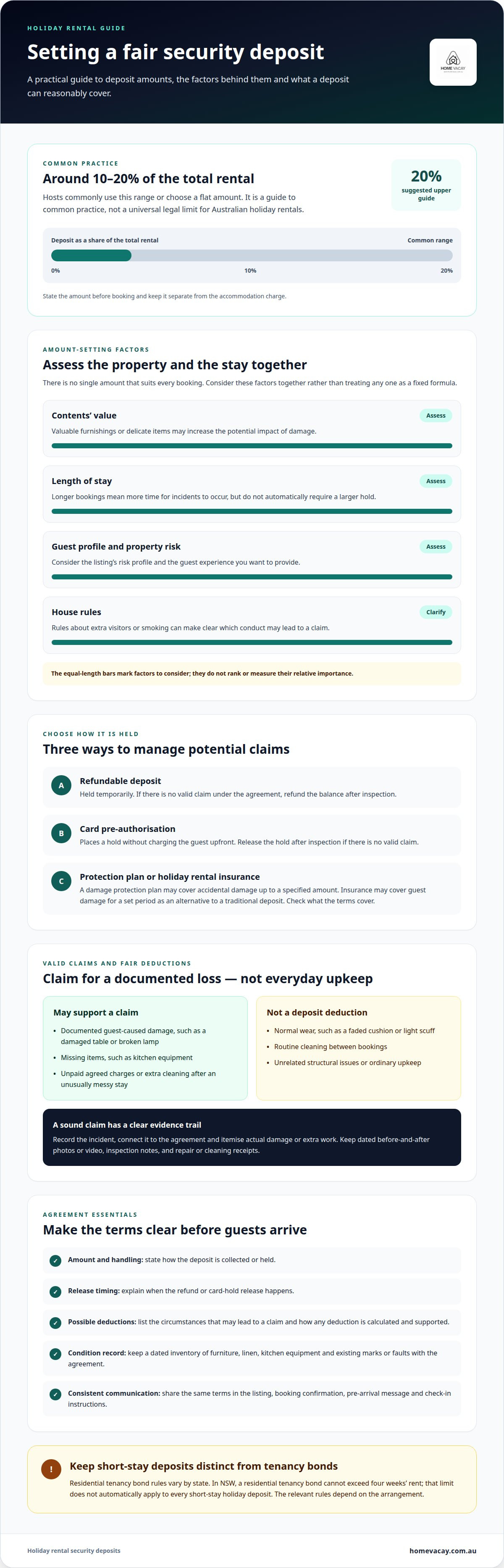
A refundable deposit is held temporarily, while a card pre-authorisation places a hold without charging the guest upfront. Either may help cover valid claims, with the balance refunded or the hold released after inspection. Damage protection plans may cover accidental damage up to a specified amount. Holiday rental insurance may cover guest damage for a set period as an alternative to a traditional deposit. The terms determine what each option covers.
Recording property condition and damage
A condition record documents the property before and after each stay, helping show whether damage occurred during a guest’s visit. Photograph or video each room, piece of furniture and appliance before check-in. After checkout, inspect the same areas and record any new damage, such as a cracked cooktop. Keep dated images with the booking agreement, inspection notes and repair or cleaning receipts. This evidence helps explain a proposed deduction.
Minor damage and normal wear
Normal wear and tear develops through ordinary use, while damage involves a specific incident or careless action. A faded cushion or light scuff may reflect regular use; a large stain or broken lamp may point to guest-caused damage. Minor wear or incidental damage may be better treated as routine upkeep than as a deposit deduction. Understanding security deposits for holiday rentals also means separating genuine loss from everyday upkeep.
Damage types and covered costs
A deposit may cover documented guest-caused damage, missing items, unpaid agreed charges or extra cleaning after an unusually messy stay. Examples include a damaged table, missing kitchen equipment or cleaning required after substantial spills. Record the incident, link it to the agreement and keep an itemised account of costs. A claim should reflect actual damage or extra work, not ordinary wear, unrelated structural issues or routine cleaning between bookings.
Rental Security Deposit: What is it and How Does it Work?
A holiday rental deposit is a temporary amount connected to a booking, separate from the accommodation payment. In Australia, residential tenancy bond rules vary by state, so do not assume a tenancy limit automatically applies to every short stay.
Typical deposit amounts
Hosts commonly set a deposit at around 10-20% of the total rental, or choose a flat amount. A suggested upper guide is 20% of the reservation total. These figures describe common practice, not a universal legal limit for Australian holiday rentals. The amount should be stated clearly before booking, so guests can understand the deposit separately from the accommodation charge and plan their payment.
Deposits for longer stays and high-value properties
A longer stay or a property with valuable furnishings may call for a different deposit amount. Longer bookings mean more time for incidents to occur, while costly contents can increase the potential impact of damage. That does not mean every extended booking needs a larger hold. Consider the property and stay together, then explain the amount in the booking terms before guests commit.
Factors affecting deposit amounts
The contents’ value, guest profile, length of stay and property risk can all influence the deposit amount. A furnished home with delicate items may have different needs from a basic listing. House rules matter, too. For instance, rules on extra visitors or smoking can clarify which conduct may lead to a claim. Set a proportionate amount that reflects the property and the guest experience you want to provide.
State and territory deposit limits
There is no residential tenancy bond limit that should automatically be applied to every holiday booking. The relevant rules depend on the arrangement, and tenancy requirements vary across Australia. In NSW, a residential tenancy bond cannot exceed four weeks’ rent. That limit relates to residential tenancy bonds, not automatically to a short-stay holiday deposit. Clear booking terms explain the arrangement and help avoid confusion with a residential tenancy.
What terms should my Holiday Rental Agreement include?
If a guest disputes a deduction, compare the written agreement with the inspection record and itemised claim. If you cannot reach agreement, seek help from relevant local authorities and provide the booking contract and evidence of the property’s condition before and after the stay.
Security deposit terms in the agreement
A holiday rental agreement should state the deposit amount, how it is collected or held, and when it will be refunded or released. It should also list circumstances that may lead to a claim, such as guest-caused damage, missing items or extra cleaning. Explain how any deduction will be calculated and supported. These details give guests a clear basis for understanding the contract before booking.
Written terms and inventories
Written terms and an inventory record what the holiday home contains and its condition before arrival. List items such as kitchen equipment, linen and furniture, and note existing marks or faults. A dated inventory helps distinguish a missing item from one that was never supplied. Keep the rental agreement and inventory together so both parties can refer to the same record if a claim arises.
Communicating terms and incidents
Share deposit terms before check-in through the listing, booking confirmation, pre-arrival message and check-in instructions. Guests should know whether a deposit applies, how it is handled, when it is released and what could trigger a deduction. A tenant and a short-stay guest may be covered by different arrangements, so use accurate, consistent language throughout the agreement and avoid describing every guest as a tenant.
If an incident occurs during a stay, record it promptly and tell the guest what happened. For example, report a damaged chair with a photo and a brief written explanation. Keep the message, image and any later repair or cleaning record with the booking documents. This creates a clear account for discussing the issue and assessing a proposed deduction.
Definition and purpose of a holiday rental security deposit
A holiday rental security deposit is money collected or temporarily held before check-in as a safeguard during a guest’s stay. It is separate from an advance booking payment, which contributes towards the accommodation price or secures the reservation. Paying part of the accommodation cost upfront, for example, does not automatically create a fund for damage claims. This distinction helps guests understand what they may get back after departure.
The deposit gives owners a way to address specific costs linked to a stay, such as guest-caused damage, missing items, unpaid agreed charges or a breach of house rules. It is not an automatic penalty or extra income. If no valid incident occurs, the deposit should be refunded or the card hold released. That makes it a temporary safeguard, not part of the accommodation price.
For a guest, the practical question is what the money secures and what could affect its return. For an owner, it provides a defined source for a valid claim, subject to the booking terms and available evidence. A broken bedside lamp, for instance, is different from one listed as damaged before arrival. Clear records help connect a deduction to an incident during the booking.
A booking platform may handle payment or communicate deposit terms, but the deposit’s purpose remains separate from the reservation itself. Guests should be able to see the amount, holding method, release timing and possible reasons for a claim before confirming. Owners benefit from applying the terms consistently to each booking. This shared understanding reduces confusion between a reservation payment, a security hold and a charge for an evidenced loss.
The key takeaway is simple: a security deposit protects against defined problems during a stay, while an advance payment secures or pays for the booking. Treating them as separate amounts helps guests understand their obligations and gives owners a fair basis for resolving genuine incidents.
Home Vacay
Home Vacay offers short-stay apartments for business and leisure travellers across selected Australian locations. Clear booking terms help you understand what to expect before arrival and distinguish accommodation payments from any refundable security hold.
Whether you are travelling for work or taking a break, Home Vacay offers apartment stays suited to different guest needs. Review the terms for your chosen booking to understand how any deposit is handled before your stay.
If you are planning a short stay, contact Home Vacay to discuss your accommodation plans.
Set your policy before the next booking
A practical understanding of security deposits for holiday rentals helps create a guest experience that feels clear from the first booking message. Treat your policy as part of the welcome, not just a safeguard. Plain language and consistent communication help guests know what to expect before their stay begins.
Use your next booking cycle to review whether your terms are easy to follow from listing to check-in. A calm, transparent approach can build confidence on both sides and leave guests more room to enjoy their time away.
If you’re planning a stay, get in touch with Home Vacay to discuss your accommodation plans. We’d be pleased to help you find a comfortable base for your time away.
Frequently Asked Questions
What is the difference between a security deposit and a booking deposit?
A booking deposit contributes towards the accommodation price or secures the reservation; a security deposit is held separately against possible claims. For example, if a booking payment is deducted from the total stay cost, it is not automatically available for damage. Check the payment descriptions in the confirmation and agreement to distinguish the amount paying for the stay from any amount that may be returned later.
When Is It Appropriate to Claim Against a Security Deposit?
A claim is appropriate when the agreement allows it and evidence shows that a guest caused a loss or breached a stated term. A broken appliance, missing item or cleaning required after an unusually messy checkout may support a claim. Keep the relevant agreement clause, inspection evidence and itemised record together. A deduction should relate to the incident, not routine upkeep or a pre-existing fault.
When Must You Refund a Guest?
Refund the deposit promptly after the post-stay inspection finds no valid claim. If a claim applies, explain the reason and amount, and return any undisputed balance. For a card pre-authorisation, release the hold when no claim is needed. The card provider may take time to show the released funds in the guest’s account, so distinguish releasing the hold from the bank’s processing time.
What is a security deposit for a holiday rental in Australia?
A security deposit is a temporary amount collected or held in connection with a short stay, rather than payment for the accommodation itself. The agreement should explain the amount, how it is held and what could lead to a deduction. This distinction helps guests understand the arrangement before arrival and helps hosts assess claims against the written terms, rather than treating the deposit as an automatic charge.
How much can Australian holiday rental hosts charge as a security deposit?
There is no national figure that applies to every holiday rental deposit. The amount should reflect the contents, property risk and stay profile, and be clearly stated in the booking terms. Do not assume residential tenancy bond limits automatically govern a short holiday booking. In NSW, for example, the four-week rent limit applies to a residential tenancy bond, not necessarily a short-stay deposit.
How do security deposits differ from bonds, pre-authorisations and damage waivers?
A security deposit is money held for possible claims; a card pre-authorisation places a temporary hold without an upfront charge. A damage waiver is a separate protection option that may cover accidental damage up to a specified amount. In NSW, “bond” generally refers to tenants’ residential tenancy security, while security deposits apply to boarders and lodgers. The booking arrangement determines which terms are relevant.


