

The lowest nightly rate isn’t always the best value. Comfortable accommodation for solo business travellers depends on the total cost, location, transport, privacy and space to work. Alternative accommodation can suit business stays of five nights or more, while shorter trips may call for different priorities.
It makes sense to find a comfortable place that fits your travel budget. The right choice depends on your schedule and what you need between meetings, from reliable Wi-Fi and accessible power outlets to a straightforward journey to your work venue.
This guide shows you how to compare accommodation costs, availability and transport, then weigh hotels, apartments and other options. You’ll have a practical way to choose a base that suits your trip, not just its nightly rate.
Key Takeaways
- Compare what each stay includes, especially the practical details that support working and arriving smoothly.
- Factor local events and travel dates into your accommodation comparison, as they can affect availability and rates.
- Choose a location around your work schedule, then weigh public transport and other ways to get around.
- Match the stay type to your trip length and priorities, balancing privacy, workspace and opportunities to connect.
1. Checking accommodation inclusions and exclusions
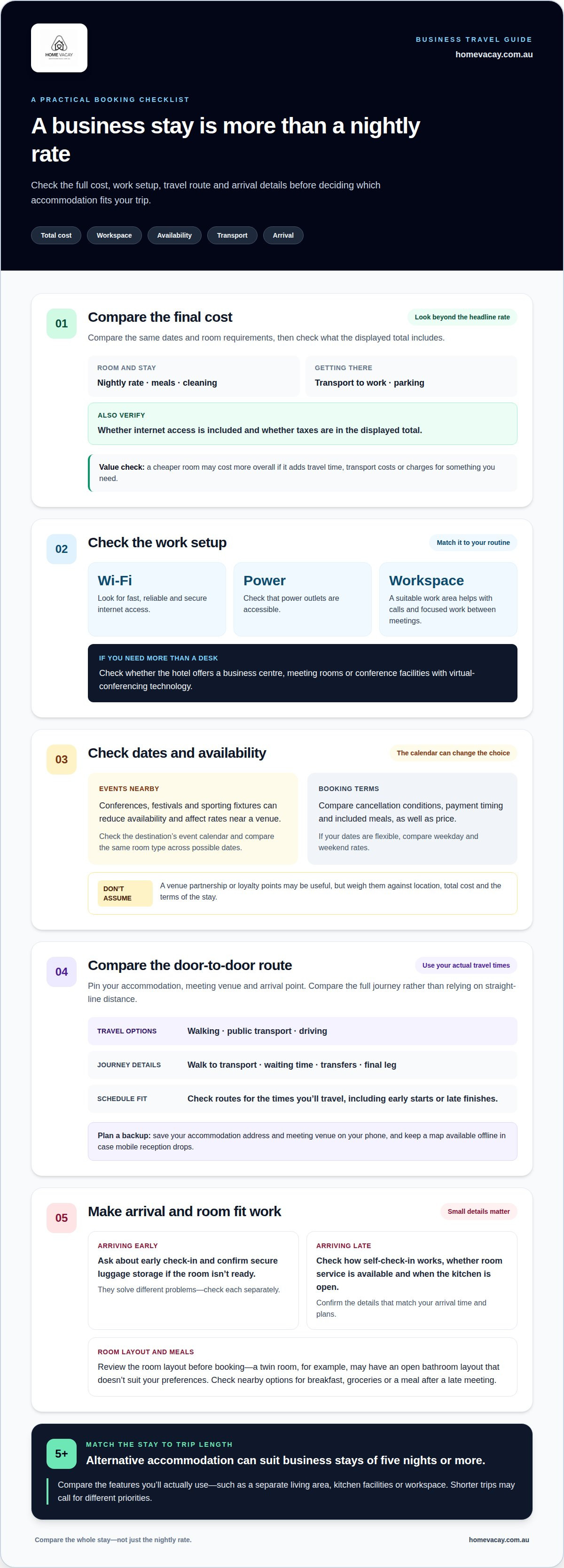
The most useful hotel amenities are fast, reliable, secure Wi-Fi and accessible power outlets. A workspace also helps when your schedule includes calls or focused work between meetings. These basics support comfortable accommodation for solo business travellers, whether the trip is within Australia or international.
Compare the listed inclusions with your routine. If you need to join a virtual meeting, look for a suitable workspace and internet access. Hotels catering to remote workers may also have business centres, meeting rooms or conference facilities with virtual-conferencing technology. Check the room layout before booking, too. A twin room, for example, may have an open bathroom layout that doesn’t suit your preferences.
Read the full cost breakdown, not just the headline rate. Look for separate charges for parking, meals, cleaning or internet access, and note whether taxes are included in the displayed total. Compare the final amount for the same dates and room requirements. This helps you spot a low rate that excludes something you need, such as parking near your meeting venue.
Check how arrival works. Some hotels have self-check-in kiosks that let guests check in, activate a key card and make dinner reservations without queuing at reception. For a late arrival, find out whether 24-hour room service is available and whether the kitchen’s hours match your plans. An international flight can also make a simple arrival process especially useful.
Arriving before the usual check-in time? Request early check-in and confirm whether secure luggage storage is available if your room isn’t ready. These are separate considerations: early access and luggage storage solve different problems. Add your arrival time to the booking notes and keep the check-in instructions handy for travel day.
2. Local events, availability and pricing
Check the destination’s event calendar before choosing travel dates. A major conference, festival or sporting fixture can reduce accommodation availability and affect rates near the venue. For example, rooms nearby may be harder to book during a large annual festival than during a quieter period. Compare the same room type across possible dates, then weigh any savings against your meeting schedule.
Location can affect your total cost as much as the nightly rate. Accommodation near a tourist centre may cost more than a similar stay farther out, while extra travel takes time and money. Compare the full cost of your stay: room rate, transport to work, parking if needed and any charges relevant to your plans. A cheaper room may not be better value if it means a long commute.
Compare booking terms as well as prices. Cancellation conditions, payment timing and included meals can affect an option’s practical value. If your dates are flexible, compare weekday and weekend rates; hotels used by business travellers may have better weekend deals when work guests leave. Loyalty points may also matter if you already use a hotel programme, but weigh them against location and total cost rather than choosing a less suitable stay just to earn points.
Plan meals around your workday and the neighbourhood. Look for a nearby bakery for breakfast, a grocery store for simple provisions or a takeaway option after a late meeting. For a meal out, choose a restaurant close to your accommodation or meeting venue. This can make evenings easier when your schedule is tight.
For event travel, check whether the venue or organiser has accommodation partnerships or preferred booking arrangements. Compare those options with other available stays, considering dates, location and terms. A partnership may simplify planning, but it doesn’t automatically make a room the best fit. Prioritise what matters for your trip, then book once your dates and schedule are settled.
3. Accessible locations and transportation
Choose accommodation based on the places you need to reach, not just a destination’s best-known attractions. Before booking, pin your meeting venue, accommodation and arrival point on a map. For example, if your first appointment is near a convention centre, compare stays by the door-to-door route rather than straight-line distance. A shorter commute can leave more time to prepare and reduce your exposure to traffic delays.
Check the actual route, not just the distance shown on a booking page. Compare walking, public transport and driving options for the times you’ll travel. A nearby bus stop may be less useful if the service doesn’t suit an early start or late finish. Note the closest stop, route changes and walking distance between the stop and your accommodation.
If you plan to use an e-hailing service, check whether it operates at your destination and whether the pickup point suits your arrival time. A marked pickup area near an airport terminal can make your transfer simpler than arranging a car on an unfamiliar street. For a late meeting, identify your return route before you leave, including a safe pickup point for your driver.
Build a practical backup into your plan. Save your accommodation address and meeting venue in your phone, and keep a map available offline in case mobile reception drops. If your workday includes appointments across a large metropolitan area, group nearby meetings together where possible. This can help you avoid crossing the area between commitments and make your daily travel plan easier to follow.
Before booking, compare the door-to-door journey for each shortlisted stay. Include the walk to transport, waiting time, transfers and the final leg to work. Choose the option that fits your schedule and travel preferences rather than assuming the closest property always offers the simplest route.
4. Alternative accommodation types for business travel
Hotels suit trips where you value reception services and a familiar room setup. Alternative accommodation can work well for longer stays, with options often equipped for business trips of five nights or more. Compare amenities you’ll use, such as a separate living area, kitchen facilities or a workspace, rather than choosing by category alone. Let your schedule and the time you’ll spend in the room guide your decision.
Serviced apartments can give you more room to settle in, but may cost more per night for short-term business stays. For a brief visit, a hotel may be a simpler fit. For an extended project, an apartment’s extra space may suit your routine. Compare the total cost and practical features for your dates, including how much time you’ll spend working from your accommodation.
Hostels can be budget-friendly and offer opportunities to meet other travellers, but shared spaces may mean less privacy and no dedicated workspace. Guest houses and inns provide a smaller setting, where owners or staff may share local insight. Think about how you’ll spend your evenings: preparing quietly, socialising or spending time outside your room. Each type of stay suits a different travel style.
Solo travellers should look for clear access arrangements, secure entry and a lockable room door. Check how keys or access codes are handled, and whether the route from the street to your room is straightforward for a late arrival. Wherever you stay, keep valuables out of sight and save the accommodation’s contact details separately from your phone.
Use your trip length and working pattern to narrow the choices. A hostel may suit a traveller prioritising social contact, while a guest house can appeal to someone seeking a smaller setting. An apartment may better suit a longer work stay with time spent indoors. Compare apartment stays for business travel with hotels and other places, then choose the option that fits your plans.
Home Vacay: Capitol Apartments in Canberra City
Home Vacay offers Capitol Apartments in Canberra City as a flexible short-term base for professionals working across the capital. Its central city location may suit a work schedule centred on nearby meetings, events or corporate appointments. Compare it with your typical destinations and transport routes, then decide whether an apartment stay fits your business trip better than a standard hotel.
Home Vacay also features options such as the Peaceful Coombs Apartment and the Luxury Apartment in Braddon Precinct. Consider each property alongside your itinerary and preferred neighbourhood, keeping in mind that the right choice depends entirely on where your work takes you.
When looking for comfortable accommodation for solo business travellers, start by identifying the Canberra precinct that best aligns with your corporate schedule. You can then review available properties to find a suitable base for your upcoming work trip.
Make your next work trip easier to settle into
Let your work schedule shape your stay, while leaving yourself room to settle into the destination. Before booking, map out the rhythm of your days: when you’ll leave, where you’ll return and whether you’ll need a quiet place to prepare. This can help you choose comfortable accommodation for solo business travellers that works beyond the working day.
A work trip doesn’t have to feel like a string of meetings and transfers. A well-chosen base can make it easier to keep evenings calm and leave room for local discovery. If Canberra is on your itinerary, consider Home Vacay’s Capitol Apartments in Canberra City alongside your other plans.
Contact Home Vacay about your stay and take the next step towards a more settled business trip.
Frequently Asked Questions
What are the needs of a business traveller?
Business travellers need a stay that supports work, rest and a straightforward arrival. A practical setup includes a suitable surface for a laptop, a comfortable chair and enough lighting for evening tasks. Consider your routine, too: someone preparing presentations may value a quiet room, while a traveller attending back-to-back meetings may prioritise easy access to transport and nearby food.
What accommodation types are best for solo business travellers in Australia?
The best fit depends on your trip length and daily routine. A hotel can suit a short visit with a packed schedule, while an apartment may feel more practical if you want room to prepare meals or settle in after work. A hostel is another option if you prefer a social atmosphere. Match the type of stay to your privacy, work and downtime needs.
How much does business-friendly accommodation cost per night in major Australian cities?
There’s no single nightly rate for major Australian cities. The price of a specific stay depends on the dates, location, property type and included amenities, and is provided after a quote request. Compare the same travel dates and requirements, then consider transport and meal costs alongside the room rate to judge your overall budget.
How can I find accommodation near Australian airports, CBDs and public transport?
Search around your actual arrival point and work address, then compare routes instead of relying only on map distance. Use a map app to check the walk to a station or bus stop, transfers and estimated journey times at the times you’ll travel. For an early flight, compare airport access with the cost and convenience of staying closer to work.
How can I verify Wi-Fi speed, noise levels and workspace quality before booking?
Look for specific listing details, such as a desk, chair and internet speed, rather than relying on broad labels like “work-friendly”. Read recent guest reviews for comments about connection reliability and street or building noise. Room photos can help you assess the workspace layout. If you’ll have video calls, consider whether the desk has a suitable background and lighting.


