

Booking directly can leave an accommodation provider with more net revenue because it avoids platform commission. Online travel platforms commonly charge 15-20% per booking, while direct bookings still carry costs such as payment processing, marketing and booking-system fees. The better option depends on what each channel costs and what the guest receives.
When weighing booking directly vs through a platform, consider convenience as well as price. Platforms make it easier to compare stays in one place, while booking direct gives you a clear line to the accommodation provider. Either channel may have exclusive offers, but neither guarantees the lowest rate.
This guide compares convenience, channel costs and net revenue, then looks at rates and direct-booking offers in the Australian market. You’ll see how to weigh the trade-offs for both guests and accommodation providers, and find a practical way to choose the channel that best suits your stay or business.
Key Takeaways
- Use booking platforms to scan a range of stays in one place, then weigh that convenience against the more direct contact a direct booking can offer.
- Work out net revenue by accounting for each channel’s acquisition and transaction costs, not just the nightly rate.
- Compare the full booking terms and any direct-only promotions, as the lowest displayed price may not be the best overall value.
- Choose a channel based on what matters most for the stay: ease of comparison, booking flexibility, personal contact or the final return.
What Are Third-Party Bookings?
Third-party bookings place an online platform between guests and accommodation providers. Before choosing, compare the convenience, booking terms and costs of each channel.
Online Travel Agencies
An online travel agency (OTA) lists accommodation alongside options from other providers. Booking through an OTA means reserving through the agency, rather than directly with the accommodation provider. The agency brings listings and booking steps together, and may offer package deals or rates that aren’t available through direct channels. With a direct booking, you use the provider’s own booking process.
Platform Convenience and Choice
Online travel platforms make it easier to find accommodation by showing options from multiple providers in one place. You can compare listings and booking details without visiting separate provider websites. Some platforms also include flights and car hire, which can simplify trip planning. A direct booking, by contrast, shows one provider’s available options. Before paying, compare the total price, cancellation terms and any extra charges shown at checkout.
Platform Commissions
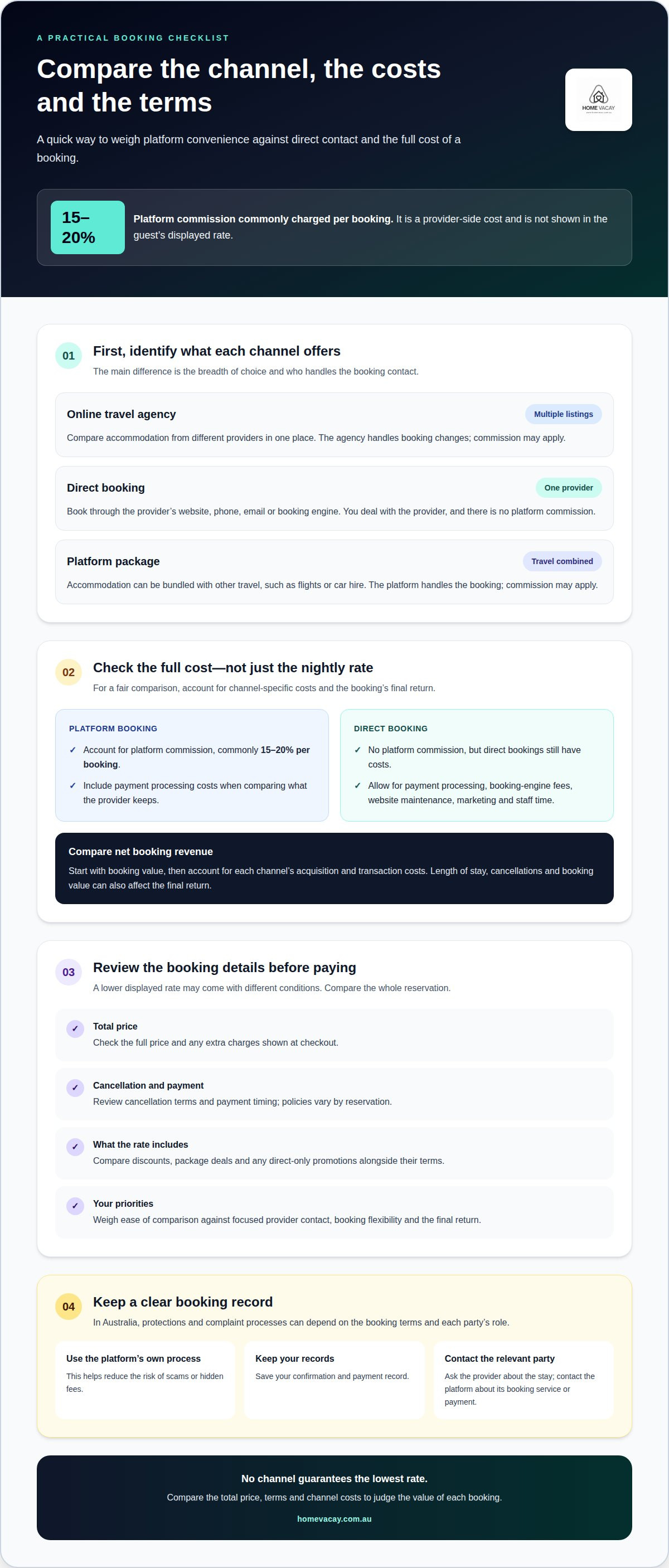
Platforms commonly charge accommodation providers 15-20% commission per booking. The guest’s displayed rate does not show this provider-side cost. Unlike a direct reservation, a platform booking can therefore bring a separate channel expense for the accommodation business.
Consumer Protections
In Australia, protections and complaint processes can depend on the booking terms and each party’s role. Cancellation and refund policies vary by reservation, whether you book directly or through a platform. If something goes wrong, contact the provider about the stay and the platform about its booking service or payment. Responsibility depends on the issue. To reduce the risk of scams or hidden fees, use the platform’s own booking process, review the full price and terms before paying, and keep your confirmation and payment record.
| Booking option | Choice | Booking contact | Provider commission |
|---|---|---|---|
| Provider website | One provider | Provider | No platform commission |
| Provider phone or email | One provider | Provider | No platform commission |
| Online travel agency | Multiple listings | Agency for booking changes | May apply |
| Platform package | Accommodation and other travel | Platform | May apply |
| Direct booking engine | One provider | Provider | No platform commission |
Choose based on the balance of comparison, booking terms and direct contact you prefer.
Booking platform convenience and search features
Online travel platforms bring accommodation, flights and car hire together in one search. Travellers can compare options without opening each provider’s page. For example, someone planning a holiday can view stays alongside transport options. This broad view can help with early planning, especially when dates or destinations are flexible. A platform can be useful for finding options before narrowing your shortlist.
Search results make it easier to scan different options. Enter your dates and guest details, then compare the listings for that trip. Check what each rate includes, its cancellation terms and any extra charges shown at checkout. A lower displayed rate may come with different conditions. Reviewing the full reservation details helps you judge value, not just the first price you see.
Direct booking offers a different kind of convenience. It shows one provider’s available accommodation, rather than the broad range of listings on a platform. In return, you deal with that provider through its own booking channel. A direct conversation can make it easier to share preferences or requirements for your stay. Platforms offer breadth, while direct channels can make communication more focused.
Start with your trip requirements, then use the channel that suits each step:
- Use a platform to scan several accommodation options and compare locations.
- Review booking details, including discounts, payment timing and cancellation terms.
- Consider a direct channel when a specific provider or guest preference matters most.
Neither approach guarantees a cheaper reservation. Prices can change with demand, timing, location and browsing behaviour. Platforms may show package deals or rates unavailable through direct channels, while direct bookings can include exclusive offers. Compare the full terms and decide what matters for your stay, rather than assuming one channel is always better.
Once you have a clearer idea of the stay you need, browse available accommodation to explore suitable options.
Comparing channel costs and net booking revenue
A displayed nightly rate doesn’t show how much an accommodation provider keeps. Compare net booking revenue after channel-specific acquisition and transaction costs. For a hotel, subtract commission and payment processing costs from platform income. For a direct reservation, include booking-engine fees, website maintenance, marketing and staff time. This gives a fairer comparison than headline rates alone.
Direct channels avoid platform commission, but still involve costs. A hotel may pay for search marketing, content optimisation and guest-retention programs. Travel agencies can bring bookings through their existing reach, while flight and accommodation packages may appeal to guests seeking convenience. Compare each channel’s total contribution after costs, not simply whether it charges commission.
That difference reflects channel costs, but it doesn’t mean every direct rate or booking produces the same result. Length of stay, cancellations and booking value also affect the final return.
Use a consistent comparison for each channel:
- Start with the booking value and length of stay.
- Subtract commission, payment processing and channel acquisition costs.
- Account for reservation-handling time and cancellations.
- Compare the resulting net revenue, including repeat bookings and additional guest spending.
For direct bookings, website and booking-engine expenses may be spread across many reservations, while transaction costs apply to individual payments. Allocate costs consistently before comparing results. Then review conversion, booking value and repeat stays alongside net revenue. A channel with fewer bookings may still contribute more per reservation, while a platform’s reach may attract guests who wouldn’t otherwise find the property. Assess both outcomes before shifting channel investment.
Direct-booking rates and exclusive promotions
Choosing booking directly vs through a platform involves more than comparing displayed rates. Australian hotels and airlines generally offer similar prices through direct and third-party channels, though travel sites may have cheaper options. Compare the same dates, room type, guest details and cancellation conditions. A rate comparison is useful only when the booking details match.
Direct channels may feature exclusive discounts, member-only rates or bundles such as breakfast or an upgrade. Frequent guests may also value loyalty benefits through a provider’s own program. Platform bookings often don’t earn full loyalty points or elite status credit. Whether direct booking is worthwhile depends on the offer and your plans, not just the channel.
Hotels and holiday rentals don’t share a single price-match guarantee. A price-match offer is a separate promotion, not an automatic benefit of booking direct. Rates can differ between channels, so compare the total price and included terms before reserving. When weighing booking directly vs through a platform, match the room and cancellation terms for a fair comparison.
Australian hotels can offer some discounts by phone that they can’t provide online. The ACCC-brokered agreement from 2016 permits this, giving guests another direct-booking option. A traveller can call to discuss an offer, then compare its final rate and conditions with the online reservation. This can be useful when an online promotion doesn’t suit the trip or when a guest wants to clarify what an offer includes.
For a like-for-like comparison, consider:
- Whether dates, accommodation type and guest details match.
- Whether discounts, breakfast or upgrades change the overall value.
- Whether loyalty points or rewards apply to that booking channel.
- Whether cancellation terms and payment conditions suit the trip.
Choose the offer that fits your stay rather than assuming one channel is always cheaper. To explore a direct stay option, browse available accommodation.
Home Vacay
Home Vacay offers short-term apartments for business and leisure stays. When comparing booking channels, consider how the accommodation fits your plans alongside the rate and booking terms. Booking directly with Home Vacay gives you a clear point of contact for your stay.
Home Vacay’s self-contained apartments suit different travel needs, including family trips and business visits. Choose an apartment that fits your plans, then review the reservation details before booking. Flexible check-in and check-out options can help you arrange your stay around your travel plans.
Contact Home Vacay to discuss your accommodation needs.
Make your next booking fit the trip
Choosing booking directly vs through a platform comes down to what matters most for your next stay. Before reserving, identify your main priority: a simpler search, a particular booking condition or a direct connection with your accommodation provider. Let that priority guide your decision instead of defaulting to the same channel every time.
After your trip, consider what worked well. Comparing options in one place may have saved time, or booking directly may have made it easier to share a preference. Reflecting on that can help you make a more considered accommodation choice next time, whether you're travelling for work or planning a family break.
If flexible accommodation suits your plans, Home Vacay has apartment options to explore Australia-wide. Talk with Home Vacay about your stay and take the next step at your own pace.
A little planning can help you choose a stay that suits the trip ahead.
Frequently Asked Questions
What are the benefits of booking direct?
Booking direct gives you a direct relationship with the accommodation provider. It can make it simpler to share an arrival preference, clarify a booking detail or discuss a change. Direct channels may also offer member rates, packages or loyalty benefits. For example, if you have a specific room request, communicating through the provider’s own reservation channel may be useful.
Is it cheaper to book hotels directly?
Not always. Australian hotels generally offer similar prices through direct and third-party channels, but an online travel agency may display a cheaper rate or package. Compare the same dates, room type, guest details and cancellation conditions. A lower headline price may not be better value if the terms differ or an included extra matters for your trip.
What is an OTA?
An OTA is an online travel agency that lets travellers search and book accommodation through its platform. It acts as an intermediary between the guest and the accommodation provider. For instance, you can view several properties in one search, then reserve through the agency rather than the provider’s own booking channel.
Why are OTAs still important in a hotel’s distribution strategy?
OTAs help hotels reach travellers who might not otherwise find their accommodation. Search and comparison tools can introduce a property to guests planning a trip, while package options may suit travellers organising several parts of their journey. Hotels can use this discovery channel alongside direct bookings, which support guest relationships and repeat business. The right channel mix depends on the property.
What are the pros and cons of booking directly versus through a travel platform?
Booking direct gives you a closer line to the accommodation provider, while a travel platform can make it easier to compare multiple stays. A direct channel may suit a traveller with a particular request; a platform may help someone still choosing a destination. Booking terms, payment arrangements and included extras vary, so weigh those details against the convenience of each option.
Are direct bookings cheaper than bookings through online travel agencies in Australia?
No channel is consistently cheaper. Australian hotels and airlines generally have similar prices across direct and third-party channels, while online travel agencies may offer cheaper options or package deals. Compare complete reservations with matching dates and inclusions. When booking accommodation, also consider cancellation conditions and payment timing, as these can determine whether an offer suits your plans.


