

The nearest stretch of sand isn’t the only factor in a restful coastal stay. When choosing a beachside short stay in NSW, consider the surroundings, how easily you can reach the coast and what the listing says about cleaning between bookings. Look for practical details about rooms and shared spaces, not just a general promise of cleanliness.
A quiet setting and a well-presented place to return to can make a trip more relaxing, whether you’re away for a few days or taking a family break. It’s reasonable to want both a coastal atmosphere and clear information about how the accommodation is prepared.
This guide explains what to look for around the property, what useful cleaning information includes and how to compare stays without relying on photos alone. Use the steps to narrow your options and choose a coastal escape that suits your pace and comfort needs.
Key Takeaways
- Choose a coastal destination by weighing the setting, travel time and nearby facilities against the pace of break you want.
- Compare seasonal rates by looking at travel dates, demand and what the booking includes, not just the nightly figure.
- Understand how NSW short-stay rules can vary by location and accommodation type before you book.
- Read the full booking terms for extra charges, cancellation conditions, check-in details and cleaning expectations.
- Use clear property information and a straightforward booking process to help assess whether a stay is legitimate and right for you.
Which NSW beachside destinations are best for short stays?
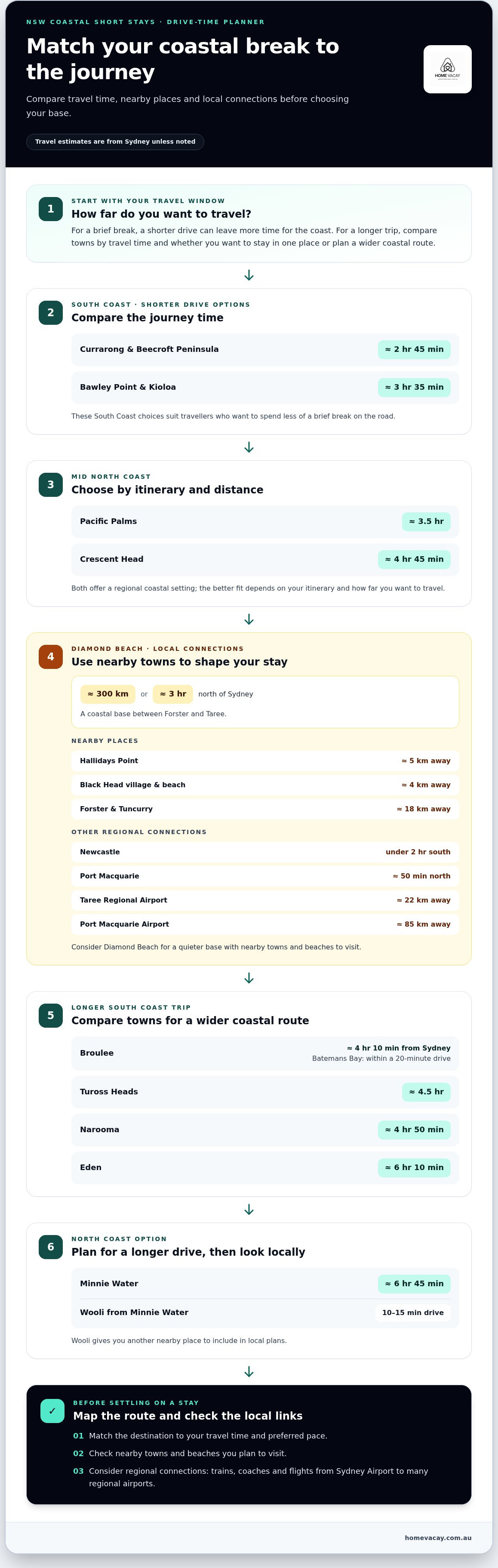
The best destination depends on your starting point, travel time and preferred pace. For a shorter drive from Sydney, Currarong and the Beecroft Peninsula are approximately 2 hours 45 minutes away. Bawley Point and Kioloa take 3 hours 35 minutes by the stated travel-time estimate. These South Coast choices suit travellers who want to spend less of a brief break on the road.
For a Mid North Coast stay, Pacific Palms is around 3.5 hours from Sydney, while Crescent Head is approximately 4 hours 45 minutes away. Both offer a regional coastal setting, with the better fit depending on your itinerary and how far you want to travel. On the North Coast, Minnie Water takes approximately 6 hours 45 minutes from Sydney. Wooli is a 10-15 minute drive from Minnie Water, giving you another nearby place to include in local plans.
Diamond Beach can work well for a coastal break centred on the area between Forster and Taree. It is approximately 300 km, or three hours, north of Sydney. Newcastle is under two hours south, while Port Macquarie is around 50 minutes north. Hallidays Point is approximately 5 km away, and Black Head village and beach are approximately 4 km away. Forster and Tuncurry are approximately 18 km from Diamond Beach.
That nearby network can help shape the stay. Choose Diamond Beach if you want a quieter base with nearby towns and beaches to visit. Taree Regional Airport is approximately 22 km away, while Port Macquarie Airport is approximately 85 km away. Travel options from Sydney to regional NSW destinations include trains, coaches and flights from Sydney Airport to many regional airports.
For a longer South Coast trip, compare Broulee, Narooma and Eden. Broulee is approximately 4 hours 10 minutes from Sydney and within a 20-minute drive of Batemans Bay. Narooma takes approximately 4 hours 50 minutes, while Eden takes approximately 6 hours 10 minutes. Tuross Heads is around 4.5 hours from Sydney. These travel estimates help you decide whether to settle in one town or plan a wider coastal route.
- For a shorter Sydney drive: compare Currarong with Bawley Point and Kioloa.
- For a Mid North Coast base: consider Pacific Palms or Crescent Head.
- For nearby town options: weigh Diamond Beach against its connections to Forster, Tuncurry and Hallidays Point.
- For a longer South Coast escape: compare Broulee, Narooma, Tuross Heads and Eden by travel time.
Before choosing, map your arrival route and the places you plan to visit. A beachside short stay in NSW is easier to plan when the destination fits your travel time, local connections and preferred pace.
What are typical nightly prices for beachside stays in NSW by season?
Nightly rates in NSW vary by travel dates, destination and property type. Summer holidays, Christmas and New Year, and Easter can bring stronger demand in coastal areas. A beachside apartment in a popular holiday town may therefore cost more or less than a smaller inland property or a stay outside peak periods. Treat the season as one factor in your comparison, not a price guide on its own.
Winter and shoulder periods may give you a different choice of dates, but rates still depend on local demand and the property. A coastal event, school holiday or limited accommodation in a town can affect your options. Compare the exact dates you can travel instead of relying on broad labels such as “off-peak”. The same property may have different rates across the calendar.
For a fair comparison, keep the main details consistent: destination, dates, guest numbers and accommodation type. Then compare what each nightly rate covers. A family apartment and a resort room may differ in capacity, facilities and booking terms, so their rates aren’t direct equivalents. The lowest nightly rate may not be the best fit for your group or plans.
- Travel dates: compare a preferred week with nearby dates if your plans allow flexibility.
- Location: distinguish a beachfront address from accommodation that requires a drive to the sand.
- Property type: compare similar rooms, apartments or resort stays with suitable guest capacity.
- Booking terms: review what the displayed amount includes and how cancellation conditions differ.
For a specific booking, the price depends on the dates, property, length of stay and guest numbers, and is provided after a quote request. These details make comparisons meaningful. A short weekend and a longer midweek visit may have different totals, even at the same address. Compare the full stay cost as well as the nightly rate.
Before choosing, note the rates for your preferred dates and an alternative period. This shows whether shifting your travel window changes the available options. Keep a short record of the property type, location, included features and booking conditions. You’ll have a clearer basis for weighing value instead of choosing by the headline nightly rate alone.
For a beachside short stay in NSW, seasonality is only one part of the decision. Match your dates and destination to the accommodation you need, then compare similar stays. If your dates are fixed, focus on property features and terms. If they’re flexible, compare nearby dates to see whether another option better suits your plans.
When booking through Home Vacay, remember that costs depend heavily on your specific dates and budget. Treat that as an entry point for comparison, not a promise that every resort or season will have the same rate. Check the quote for your chosen stay and compare its inclusions and booking terms with other suitable options. A starting price can help frame a search, while the dates and property details determine whether a particular stay fits your plans.
What are the NSW rules for short-term rental accommodation?
NSW short-term rental accommodation rules depend on the property’s location and whether the stay is hosted. The planning framework commenced on 1 November 2021. It sets requirements for registration, fire safety and, in some areas, limits on non-hosted bookings. A beachside address alone doesn’t tell you which local rules apply. Greater Sydney, Ballina and parts of Clarence Valley have specific day limits.
According to NSW Government, non-hosted short-term rental accommodation in Greater Sydney, the Ballina area and certain land in the Clarence Valley area is limited to 180 days a year. The limit applies to the accommodation’s location and hosted status. It shouldn’t be assumed to apply across every NSW coastal town. For example, a property in a named region outside those areas may be subject to different local conditions.
Booking duration also matters. According to NSW Government, bookings of 21 consecutive days or more are exempt from the day limits for non-hosted short-term rental accommodation. This exemption concerns day limits, so it shouldn’t be read as removing other requirements. Hosts still need to meet applicable registration and safety obligations. Guests can use the booking dates and property location to understand which parts of the framework may be relevant.
Registration is a host obligation, not an extra guest charge. According to NSW Government, a new NSW short-term rental accommodation registration costs A$65, while renewal costs A$25 per year; these are registration costs, not nightly accommodation rates or booking fees.
The framework also set a deadline for host compliance. According to NSW Government, it requires hosts to register dwellings and comply with new fire safety standards by 1 March 2022. The NSW mandatory Code of Conduct for the Short-Term Rental Accommodation Industry applies obligations to booking platforms, hosts, letting agents and guests. Together, registration, safety and conduct requirements form separate parts of the rules.
For a practical booking check, work through these steps:
- Identify the location: note the council area and whether the property sits within Greater Sydney, the Ballina area or specified Clarence Valley land.
- Understand the hosting type: distinguish hosted accommodation from non-hosted accommodation before applying day-limit information.
- Count consecutive booking days: use the full booking period to see whether the 21-consecutive-day exemption may be relevant.
- Separate costs: treat host registration fees as different from the amount charged for your stay.
These steps help you understand NSW requirements without treating every beach town alike. A short coastal booking and an extended booking may fall under different parts of the framework. Consider the location, hosting arrangement and length of stay before reserving.
What extra fees and booking conditions should guests check
Compare the full booking total, not just the nightly rate. A booking summary may list accommodation charges separately from cleaning, platform or service fees. Read each line before paying. If the final checkout includes a charge that wasn’t in the earlier quote, pause and reconcile the totals before confirming.
Look closely at cleaning charges for a short coastal stay. A fee may cover preparation between guests, while checkout instructions may still ask you to remove rubbish or wash dishes. Read both the fee breakdown and departure tasks. Check whether linen, towels and end-of-stay cleaning are included or charged separately.
Cancellation terms affect the cost of changing your plans. Find the deadline for a full or partial refund, and check how the policy handles a shortened stay. Note whether the booking becomes non-refundable after a particular date or payment. Save the terms shown at checkout with your booking confirmation, so you can refer to the agreed conditions.
Payment conditions matter too. Review when the first payment is taken, when any balance is due and what happens if a payment fails. Check for a security deposit or card pre-authorisation, including when it is released and when deductions may apply. This helps distinguish a temporary hold from an accommodation charge.
- Guest details: confirm the maximum occupancy and enter the correct number of adults and children.
- Arrival arrangements: note check-in and checkout times, key collection instructions and any late-arrival process.
- Property rules: look for conditions on pets, smoking, visitors, parties and noise.
- Included facilities: confirm whether parking, Wi-Fi, linen or beach equipment is part of the reservation.
- Changes: read how name changes, date changes and additional nights are handled.
Make a simple comparison before booking. Record the total payable, included services, cancellation deadline and arrival instructions for each property. This makes differences clear, even when two coastal stays show similar nightly rates. Keep the booking terms and payment receipt together for easy reference during your stay.
For a beachside short stay in NSW, the clearest choice is one whose total cost, rules and arrival steps you understand before paying. Read the checkout page from top to bottom. Confirm that the dates, guest count and selected property match your plans, then keep the confirmation for reference.
NSW accommodation includes camping and caravanning, B&Bs, pubs, motels, heritage guesthouses, farm stays, eco-retreats, luxury hotels and spa resorts. Since these options can differ considerably, compare the conditions that matter for your type of stay rather than assuming similar labels mean similar inclusions. Read the accommodation description and booking terms, then compare the listed services with the total payable and departure requirements.
Before confirming, make sure the conditions you recorded apply to your selected property and room. If anything is unclear, ask through the booking channel and keep the response with your confirmation. A written record helps you check what’s included, what you agreed to pay and which arrival or departure instructions apply. This final review can help ensure the reservation’s conditions fit your plans.
How can I find and book a legitimate beachside short stay in NSW
Start with a specific NSW town and travel dates. Search results may mix beachfront homes, coastal apartments and properties that require a drive to the sand. Read the location description carefully: “near the beach” doesn’t necessarily mean direct beach access. Compare the map with the listing details to see whether the location suits your plans.
Next, check that the listing clearly describes the accommodation. Look for photos of the sleeping areas, bathroom, kitchen and exterior, then compare them with the written description. A family stay listing should explain sleeping arrangements and guest capacity. Information about parking, stairs and shared spaces can also help you decide whether the property suits your group.
Review the host or booking business details alongside the listing. The name on the property page should match the name on the booking and payment screens. Read guest feedback for useful specifics, such as check-in or whether the accommodation matched its description. A pattern of relevant feedback gives more context than a single general compliment.
Before paying, use this sequence:
- Confirm the dates and address: check the town, property location, arrival date and departure date.
- Read the full total: compare the amount at checkout with the earlier quote and note each listed charge.
- Review the terms: find cancellation conditions, payment timing and any deposit arrangements.
- Save the records: keep the listing details, booking confirmation and payment receipt together.
Follow the stated booking process and keep payment within it. Be cautious if someone asks you to move the conversation or payment outside the named booking channel. A convincing photo alone doesn’t show who controls a property. Clear terms, consistent business details and written confirmation give you more useful information to assess.
Read the arrival instructions before finalising your travel plans. Check how keys are collected, whether on site or through another stated arrangement. Make sure the check-in time works with your transport, especially if arriving by coach or regional flight. Keep the supplied arrival details accessible rather than relying on a last-minute search after reaching town.
For a beachside short stay in NSW, make sure the listing’s location and booking details fit your plans. If you’re also planning a city stay, explore short-stay apartment options for a separate part of your trip. Choosing a beachside short stay in NSW with clear details helps you book with greater confidence.
Home Vacay: Capitol Apartments in Canberra City
Home Vacay offers Capitol Apartments in Canberra City for travellers with plans that include a Canberra stay. It isn’t a beachside option, but it may suit a separate city visit before or after time on the NSW coast. Families can also consider Peaceful Coombs Apartment for Families, while Luxury Apartment in Braddon Precinct offers another Canberra location.
Choose accommodation based on your itinerary and the kind of stay you need. Home Vacay’s short-stay apartments provide a Canberra base for business and leisure travellers, rather than a coastal setting. If your journey combines city and coast, plan each stay around its location and purpose.
Contact Home Vacay to explore its Canberra apartment options.
Plan a coastal break that suits your next step
A good coastal break starts with a clear idea of what matters most: time outdoors, a quiet place to unwind or a practical base for exploring the coast. Keep those priorities in mind as you compare accommodation, and choose a stay whose setting and terms suit your trip.
A beachside short stay in NSW can give you a slower pace and time by the water. If your plans also include Canberra, Home Vacay’s short-stay apartments provide a separate city option. Coastal accommodation and a Canberra stay serve different parts of an itinerary, so choose each for the location you need.
Planning a beachside short stay in NSW around your own priorities can help the trip feel settled from the first night to the last. Contact Home Vacay about your stay if a Canberra stop is part of your plans. Enjoy choosing a setting that feels right for the journey ahead.
Frequently Asked Questions
What does “beachside short stay” mean in NSW?
A beachside short stay in NSW is temporary accommodation near the coast, booked for a limited visit rather than as an ongoing home. The phrase describes location and duration, not a particular accommodation type. It could mean an apartment close to the shore or a coastal home farther from direct beach access. Check the listing’s address and map to understand the setting.


