

A relocation stay should do more than fill the gap between arrival and a permanent address. The right short term rentals for relocating employees can provide a comfortable base while someone settles in, even when arrival dates or move-in plans are still taking shape.
Choosing that base takes a little planning. Employees need accommodation that suits their work and household routines, offers the privacy they want and fits the temporary-stay budget. The booking dates and arrangements also need to work with plans that may change.
This guide compares apartment stays, hotels and longer-term rentals, then outlines what to consider when choosing a furnished place for the transition. Home Vacay offers self-contained short-term apartments, direct booking and flexible check-in and check-out options for business and leisure stays.
Key Takeaways
- Use short term rentals for relocating employees as a temporary base between arrival and a longer-term housing decision.
- Compare apartments, hotels and residential rentals by privacy, everyday routine, flexibility and likely commitment.
- Start with the employee’s arrival and move-in windows, then account for household needs and work routines.
- Keep dates, guest details, arrival plans and booking records together so changes are easier to manage.
- Consider whether a self-contained Home Vacay apartment, direct booking and flexible check-in and check-out suit the transition.
Why short term rentals help employees settle during a relocation
A relocation rarely lines up neatly with a new home’s move-in date. An employee may arrive before their belongings, wait for a purchase or rental to be ready, or start a temporary assignment while longer-term plans take shape. Short-term accommodation can bridge that gap, giving them time to understand their new routine before choosing a permanent home.
A short-term rental is temporary accommodation for the transition between arriving in a new place and deciding where to live longer term. It provides somewhere to stay for a defined period; a residential lease is a separate arrangement for renting a home.
The broad short-term rental overview describes a range of temporary stays and uses, including accommodation during relocation. For employees, the practical question is whether the stay supports the move from arrival to a settled daily rhythm.
When does a relocating employee need a short stay?
A short stay can suit an employee who starts a new role before their permanent home is ready, or whose work assignment has a set end date. It can also cover the settling-in period while they get familiar with their routine, commute and local services.
Someone moving alone may want a practical base while they focus on work and organise the next steps. A partner or family may need space to establish shared routines. In either case, temporary accommodation can provide time to make a housing decision without rushing it.
What makes a rental suitable during a work move?
A furnished, self-contained setting can help an employee manage everyday routines without treating each evening like another night away. Privacy matters too. A separate place to unwind after work can make a temporary stay feel more personal and help distinguish work time from downtime.
Needs vary, so start with the employee’s work commitments, household and likely length of stay. A solo employee on a short assignment may have different priorities from a family waiting for a home to become available.
Before choosing an option, consider how the stay will work in practice:
- Work rhythm: Consider where the employee needs to be and how their usual working day will run.
- Household needs: Account for whether the employee is travelling alone or with a partner or family.
- Transition timing: Map the gap between arrival, starting work and moving into longer-term housing.
Short term rentals for relocating employees are most useful when the accommodation supports both the immediate move and the routine that follows. Home Vacay’s self-contained short-term apartment stays provide a base for business travellers during that transition. Direct booking and flexible check-in and check-out options are also practical details to consider when planning the stay.
Compare short-term apartments, hotels, and residential rentals
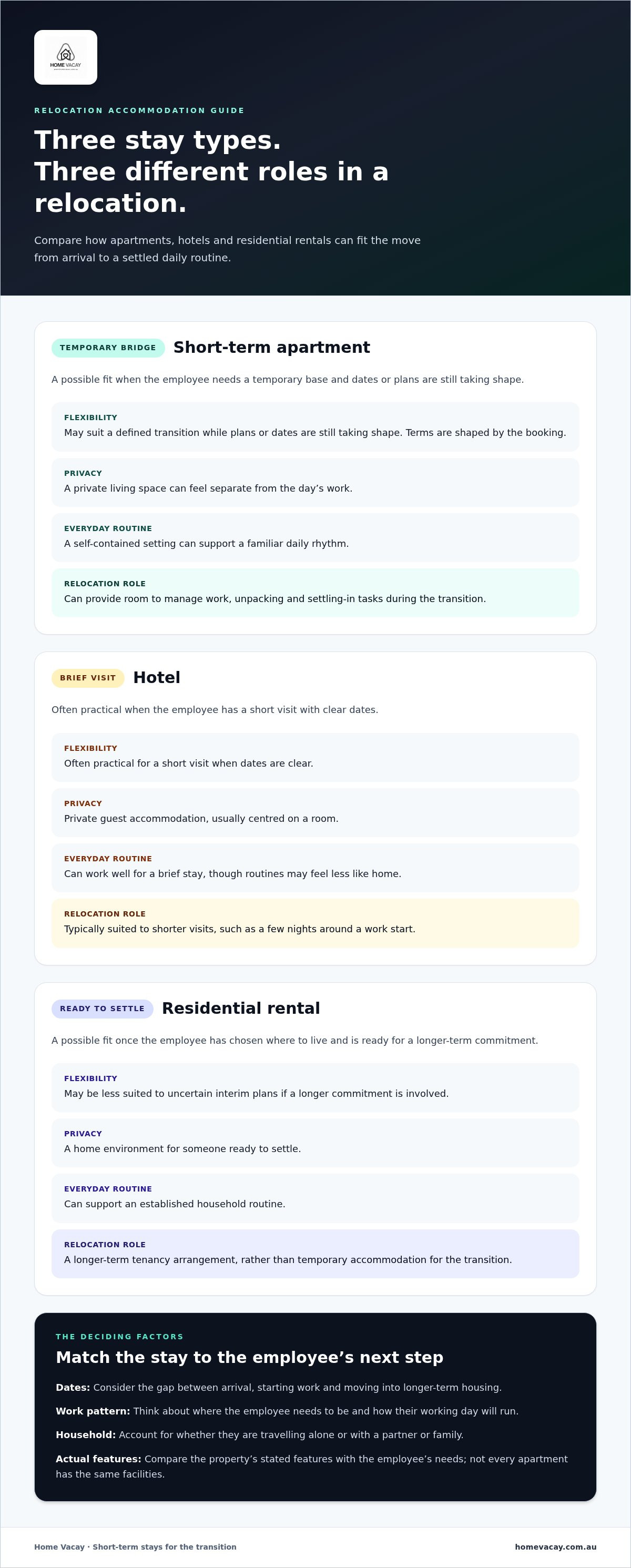
Each accommodation type suits a different stage of a relocation. A hotel can work for a brief visit or a few nights around a work start. A short-term apartment may better support everyday routines. A residential rental is generally a better fit once the employee is ready to choose a home and make a longer-term commitment.
Compare what each option offers in practice, rather than relying on the label. Features and booking arrangements vary, so use this table as a guide, then compare the details of the actual stay.
| Option | Flexibility | Privacy | Everyday routine | Likely commitment |
|---|---|---|---|---|
| Short-term apartment | May suit a defined transition when plans or dates are still taking shape. | A private living space can feel separate from the day’s work. | A self-contained setting can support a familiar daily rhythm. | Temporary stay, with terms shaped by the booking. |
| Hotel | Often practical for a short visit with clear dates. | Private guest accommodation, usually centred on a room. | Can work well for a brief stay, though routines may feel less like home. | Typically suited to shorter visits. |
| Residential rental | May be less suited to uncertain interim plans if a longer commitment is involved. | A home environment for someone ready to settle. | Can support an established household routine. | Longer-term tenancy arrangement. |
For short term rentals for relocating employees, the key question is how well the stay bridges the move. An employee working irregular hours may value privacy, while someone arriving with family may need a setup that suits shared routines. Match the accommodation to the employee’s work pattern, household and likely next step rather than assuming one option suits everyone.
When might an apartment suit better than a hotel?
A self-contained apartment can give an employee room to manage everyday routines in a private setting, rather than using the accommodation mainly as a place to sleep. That can be useful when work, unpacking and settling-in tasks compete for attention. The right fit still depends on the household, work pattern and length of stay. Compare the property’s stated features with the employee’s needs instead of assuming every apartment has the same facilities.
When is a residential rental the better fit?
A residential rental may suit someone who has chosen where to live and is ready to make a longer-term commitment. If the employee is still learning their routine or waiting for work and housing dates to become clear, a short stay can provide time to decide. Temporary accommodation and a residential tenancy are different arrangements; this comparison is practical guidance, not legal advice.
Home Vacay’s short-term, self-contained apartments are one option for employees who want a temporary base while they adjust. Explore Home Vacay apartment stays as you compare the accommodation that fits the transition.
How to choose a short term rental for a relocating employee
Build a shortlist around the employee’s circumstances, not a generic property checklist. Work through five points: dates, household, work needs, stay arrangements and booking details. This keeps the choice grounded in the move and helps narrow down short term rentals for relocating employees without assuming everyone needs the same setup.
Start with the employee’s timeline and household
First, establish the likely arrival and move-in windows. Record the work start date, the expected timing of a housing decision and any dates that may shift. Then note who is travelling and what kind of space will work for them. A solo employee and a family may have different priorities. If the permanent move-in date is uncertain, treat it as an estimate rather than a fixed end date for the temporary stay.
Assess work routines and booking details
Consider the employee’s working pattern. They may need a quiet place to focus, or simply a comfortable base between work commitments. Compare accommodation details with those needs rather than assuming particular facilities are included. Review check-in and check-out arrangements, booking terms and the expected stay length together. A clear business accommodation planning brief can help coordinators keep these details consistent.
Use this five-step process to shape the shortlist:
- Dates: Note the expected arrival, first workday and likely move-in window. Mark dates that may change.
- Household: Confirm the number of guests and whether a partner or family will stay. Match the accommodation setup to the group.
- Work needs: Consider work hours, privacy and the employee’s daily routine. Focus on what will make the stay workable.
- Stay arrangements: Compare the likely length of stay with the booking terms. Consider how a change in move-in timing could affect the plan.
- Booking: Keep guest details, selected dates and booking records together. Make sure the employee and coordinator are working from the same information.
Dates and household needs define the stay. Work routines help refine the choice, and booking details bring the plan together. Following this order helps avoid choosing accommodation based only on the first available dates or a general idea of what a relocating employee might need.
The strongest relocation stay matches the employee’s dates, household and work routine, while leaving room for plans to change.
When booking a Home Vacay apartment stay, direct booking and flexible check-in and check-out options are practical details to factor into the plan. They can help coordinators organise around the employee’s expected arrival and daily routine.
Plan a relocation stay around dates, routines, and responsibilities
A well-organised temporary stay depends on shared information. The employee needs clear arrival details, while the coordinator needs a record of dates and responsibilities. Keeping these details aligned can prevent a small change to the work or housing timeline from becoming last-minute confusion.
Use this checklist to keep the plan practical:
- Dates: Record the intended arrival and departure dates, the employee’s work start and the expected housing milestone. Mark dates that may change.
- Guest details: Confirm who will stay and that the booking reflects the correct guest count.
- Arrival plan: Note the employee’s expected arrival time and share essential check-in information before travel.
- Booking records: Keep the booking confirmation, stay dates and relevant arrival details together. Make them accessible to the employee and coordinating contact.
- Responsibilities: Set out who is arranging the accommodation, who is responsible for payment and who can help with internal relocation or travel questions.
What should be organised before arrival?
Before travel, compare the booking dates with the employee’s expected arrival and housing plans. Confirm the guest count and arrival arrangements in the booking, then send the relevant check-in information to the employee. Keep the same details available to the relocation coordinator so both can refer to one clear record if plans shift.
This preparation gives the employee a clear first step after arrival and helps distinguish confirmed details from estimates. For example, record a tentative move-in date as an expectation, not as a settled departure date for the temporary stay.
How can an employer support a comfortable transition?
Be clear about who arranges and pays for the temporary accommodation. Give the employee a named internal contact for relocation or travel questions, and explain how updates to the work or housing schedule will be shared. As the permanent housing timeline develops, review the planned end date and next steps together.
Short term rentals for relocating employees work best when the accommodation plan follows the move’s real milestones. The work start date may be fixed while the move-in date remains uncertain, so note which details are firm and which are still subject to change. If the timeline moves, update the employee and coordinator using the same booking record rather than relying on separate messages or memory.
Use the same clear approach when planning a short-term apartment stay: keep dates, arrival arrangements and responsibilities visible to everyone involved. An organised plan gives the employee more room to focus on settling into work and everyday life.
Home Vacay offers short-term, self-contained apartment stays, with direct booking and flexible check-in and check-out options to consider as part of relocation planning. Explore Home Vacay apartment stays as a potential temporary base during the transition.
How Home Vacay can make a relocation stay feel more settled
A move brings plenty of change. A comfortable base gives an employee somewhere to return to while work, housing plans and everyday routines take shape. Home Vacay offers short-term, self-contained apartment stays for business guests, making them an option during a work relocation.
For short term rentals for relocating employees, the aim is to find a stay that fits the person’s transition, not simply fill a gap in the calendar. A self-contained apartment provides a private place between work commitments and can support a more familiar daily rhythm while the employee gets established.
A temporary base for work and everyday life
An employee travelling alone may want a calm place to return to after work. Someone relocating with a partner or family will have different needs, including a setup that works for the whole household. Home Vacay’s apartments are self-contained and available for business and leisure stays. Guide the choice by the guest count, dates and routine the employee hopes to maintain.
Use the employee’s priorities to guide the choice rather than assuming every stay has the same features. Consider the expected arrival, how long the temporary stay may be needed and whether the household’s needs could change. Then compare the apartment details with those priorities.
- For an individual: Consider whether the stay offers a comfortable base around work commitments and time to unwind.
- For a household: Compare the guest details and stay arrangements with who is relocating.
- For changing plans: Keep the intended dates and likely move-in timing in view as plans develop.
Taking the next step with Home Vacay
Start with the employee’s intended dates and household needs, then explore the apartment options that suit the move. Guests can book directly through the website, and flexible check-in and check-out options can help when planning arrival and departure. Share the relevant booking details with the employee and coordinator so everyone can plan from the same information.
A settled relocation doesn’t require every part of the move to be decided at once. A suitable temporary base can give an employee room to establish a work routine and consider the next housing step at a comfortable pace. Review the stay details together and keep the booking aligned with the move as it unfolds.
Explore Home Vacay apartment stays and consider which option fits the employee’s dates and household.
Give the transition room to take shape
A relocation doesn’t need to be fully mapped out before the first day in a new role. Agree on what’s known, what may change and when the accommodation plan will be reviewed. This gives the employee and coordinator a shared reference point as work and housing plans develop.
For short term rentals for relocating employees, the right choice fits the person’s needs at this stage of the move. Let the employee’s dates, household and daily routine guide the decision rather than trying to resolve every future housing question at once.
Home Vacay offers a direct way to explore apartment stays for a work relocation, with flexible check-in and check-out options to consider as plans come together. Compare the intended stay with the employee’s needs, then choose a manageable next step.
Explore short-stay apartments with Home Vacay and give the next chapter a comfortable place to begin.
Frequently Asked Questions
How long should an employee book a short-term rental for during a relocation?
Book for the period the employee reasonably expects to need, based on work dates and the next housing milestone. If the move-in date is uncertain, don’t treat an early estimate as guaranteed. Set a review point before the planned departure and update the accommodation plan as details become clearer. The right duration depends on the assignment, household and relocation timeline, not a standard number of nights.
Can an employer book a short-term rental for a relocating employee?
Yes, an employer can arrange accommodation on an employee’s behalf. Agree internally on who will make the reservation, whose details will be used and how payment and changes will be handled. Share the booking information with the employee so they can prepare for arrival. Keeping one person responsible for updates can help avoid confusion if dates or guest details change.
What happens if an employee’s move-in date changes?
The booking holder should review the reservation terms as soon as the housing timeline shifts. Those terms set out the available options for date changes or other adjustments, so don’t assume a booking can be extended or shortened automatically. Update the employee and coordinator using the same confirmed details. If the original end date no longer fits, revise the accommodation plan around the new housing milestone.
Is a short-term apartment suitable for an employee relocating with family?
It can be, provided the apartment’s stated guest capacity and setup suit everyone travelling. Consider the family’s needs, how they’ll share the space and whether the expected stay gives the household enough room for daily life. A solo traveller’s priorities may differ from a family’s. Compare the property details with the actual household rather than relying on a broad label.
What details should a relocation coordinator provide when booking accommodation?
Provide the intended dates, names and number of guests, and an estimated arrival time. Include a clear contact for the employee and the person coordinating the booking, plus any work or housing dates that affect the stay. Confirm who is responsible for payment and keeping the reservation record. Before travel, share the arrival information the employee needs so they aren’t relying on last-minute messages.
Should a relocating employee choose a hotel or a short-term rental?
Choose based on how the employee expects to use the accommodation. A hotel may suit a brief visit focused on meetings and overnight stays. A short-term rental can fit better when the employee wants a private base for a regular day-to-day routine. Consider the household, work schedule and likely length of stay, then compare the property details and booking terms. There isn’t one best option for every move.
Can a short-term rental work while an employee searches for a permanent home?
Yes. It can give an employee somewhere to stay while they view homes, consider their commute and decide what suits their longer-term needs. This can be useful if they want to understand their new routine before committing to a particular home. Keep the temporary booking separate from the permanent housing search, and review its end date as the search progresses. Short term rentals for relocating employees can bridge that gap without deciding the long-term choice.


