

The accommodation label doesn’t always tell you what daily life will feel like. To weigh the pros and cons of serviced apartments vs short term rentals, look beyond the name and compare the practical details: service arrangements, privacy, facilities and the full booking cost. These can vary from one property to another, even within the same category.
Both options can offer more room and independence than a standard hotel stay, but the day-to-day experience may differ. The right fit depends on your trip, who’s travelling and how much support you want during your stay.
This guide compares service, privacy, facilities, flexibility and value. It also explains how to check a listing against your routine, so you can choose a comfortable and practical stay without paying for extras you don’t need. A self-contained short-term apartment can suit travellers who prefer an independent routine, with flexible check-in and check-out options for different travel plans.
Key Takeaways
- Accommodation labels can overlap, so compare the stated services and inclusions rather than relying on the name alone.
- Use the pros and cons of serviced apartments vs short term rentals to weigh privacy, independence, facilities and service against your trip needs.
- Consider whether a more defined service arrangement or a more independent routine matters most to you.
- Choose based on your trip purpose, length, group needs, service expectations and essential facilities.
- Home Vacay offers self-contained short-term apartments for business and leisure stays, with flexible check-in and check-out options.
Serviced Apartments vs Short-Term Rentals: What Is the Difference?
The terms serviced apartment and short-term rental can overlap. A furnished apartment might be described by its layout, the services available or the length of the booking. The label alone doesn’t guarantee a particular level of housekeeping, reception support, facilities or guest assistance. Those details vary between operators and properties.
A serviced apartment is generally an apartment-style stay with some services arranged as part of the accommodation. A short-term rental is temporary accommodation booked for a limited stay, often in a furnished home or apartment. Neither term tells you every detail of the guest experience. For broader background on the term, see this Serviced Accommodation Overview.
Service level and independence matter more than the label. To assess the pros and cons of serviced apartments vs short term rentals, compare what each stay provides with the routine you want. A guest who values a defined service structure may focus on different details from someone who prefers to manage their own day in a self-contained space.
What does serviced apartment accommodation usually mean?
A serviced apartment combines an apartment-style layout with services arranged by the operator. Housekeeping, reception and other inclusions vary, so the name doesn’t establish what’s included or how often support is available. Read the property details to understand the specific arrangements.
Keep the layout and service offering separate when comparing options. A living area or kitchen describes the space; it doesn’t tell you whether housekeeping or reception is provided.
What counts as a short-term rental?
A short-term rental is furnished accommodation booked temporarily rather than as a permanent home. It might be an apartment or another type of property. The term doesn’t come with a single service model: facilities, host support and arrival instructions can differ from one stay to another.
One listing might describe a self-guided arrival process, while another explains a different way to access the property. These are examples, not rules for the category. Look for the specific facilities and instructions that matter to your plans.
The categories aren’t mutually exclusive. A serviced apartment can also be booked for a short-term stay, so one description doesn’t rule out the other. Think of “serviced” as a clue about the possible service arrangement and “short-term” as a description of the booking period. A property may fit both, but its actual inclusions depend on the listing.
For a useful comparison, note the accommodation type, stated services, facilities and arrival arrangements for each option. Then compare them with your likely routine. If you’ll be out for most of the day, some services may matter less than convenient facilities or an independent routine. If support is important, pay closer attention to how it is described and when it is available.
Separating these details makes it easier to judge what a stay will actually be like. You’re comparing the practical experience of each property, not relying on a label to promise a particular standard. That gives you a sound starting point for assessing privacy, facilities and flexibility.
How Service, Privacy and Facilities Can Differ
The day-to-day experience depends on the arrangements for each property. A serviced apartment may have scheduled housekeeping or reception support, while another may offer a different level of service. Short-term rentals also vary: some involve more guest self-sufficiency, while others provide defined support and arrival instructions. Neither category guarantees one standard routine.
The apartment describes the format; the services describe what comes with the stay. Keep those points separate as you compare options. A private layout can give you room to settle in, but it doesn’t tell you whether cleaning, guest support or particular facilities are included.
Housekeeping and guest support: what should travellers expect?
Some accommodation includes scheduled housekeeping or a reception area. In other stays, guests manage more of the day-to-day arrangements themselves. Support channels and response arrangements also depend on the property. Read the stated inclusions and stay information to understand what help is available, how arrival works and which tasks are your responsibility.
Check whether any housekeeping is scheduled or available on request, if that detail matters to you. For support, look for the stated contact method and any information about when assistance is available. This helps you compare the actual arrangements instead of assuming that a particular label guarantees a certain level of service.
Privacy, space and everyday facilities
An apartment-style layout may make it easier to settle in, particularly if you want some separation between sleeping, relaxing and working. A property with shared or managed spaces can feel different from a more private, self-contained stay. The actual layout and facilities determine the level of privacy, not the accommodation label.
Think through your routine before booking. If you plan to prepare meals, check that the listing names the facilities you need. If you’ll work during your stay, look for details that show whether the space suits that purpose. Laundry access may matter on a longer trip, while a shorter visit may call for fewer facilities. Don’t assume a kitchen, laundry or workspace is included unless the property information says so.
Furnished accommodation can be presented in different ways for different stay lengths. For example, Landing's furnished apartment offerings provide a reference point for how a provider describes furnished stays. That example doesn’t set a standard for all properties. Compare each listing’s stated facilities, service arrangements and arrival details with your own plans.
When weighing the pros and cons of serviced apartments vs short term rentals, focus on the routine each stay supports. A business traveller might value a quiet place to prepare for the next day. A family may put more weight on privacy and practical space. In either case, the best fit depends on the property details and how you expect to use them.
If an independent routine suits your plans, explore self-contained short-term apartment stays from Home Vacay. Flexible check-in and check-out options can accommodate different travel plans.
Pros and Cons of Serviced Apartments vs Short-Term Rentals
Neither type of stay is automatically better. A serviced apartment may appeal if you value a more defined service arrangement. A short-term rental may suit you if independence and control over your routine matter more. The trade-offs depend on the property, your trip and how much you want to manage yourself. Use this comparison as a starting point, then assess the details of each stay.
Service: Serviced apartments may offer more structured services, which can make a stay easier to plan. The level of service still varies by property. Short-term rentals may involve more self-sufficiency, though support arrangements differ between stays.
Privacy: Either option may offer a private apartment layout. A serviced property may also have shared or managed spaces. Check the accommodation details to see which areas are private and whether any spaces are shared.
Independence: Short-term rentals can suit guests who want to organise their days around their own plans. That freedom may also mean taking more responsibility for arrival, everyday tasks or finding support.
Facilities: Both types vary in what they provide. A serviced apartment may list facilities alongside its service offering; a short-term rental may provide a self-contained setting. Compare the stated inclusions rather than assuming either category comes with a particular facility.
Suitability: A defined service routine may suit a work trip or a longer visit where predictability helps. An independent apartment stay may suit a family or leisure traveller who wants to settle into their own rhythm. The best fit is the one that makes your stay easier.
When a serviced apartment may be the better fit
A serviced apartment may suit travellers who want clearly described services as part of their stay. For a work trip, a predictable routine can make it easier to plan around meetings and rest. The same structure may be welcome on a longer visit. Still, the label doesn’t guarantee a particular service level or set of facilities. Review the stated arrangements and decide whether they match what you’ll use.
When a short-term rental may be the better fit
A short-term rental may work well if you value an independent stay and apartment-style living. Families and leisure travellers may appreciate being able to shape the day around their own plans. The trade-off is that you may need to manage some everyday arrangements yourself. Before booking, understand the inclusions, host support and arrival instructions so you know what to expect.
For a practical decision, rank what matters most: service, privacy, independence, facilities or a predictable routine. Compare each property against that short list. One option may offer the service structure you want but feel less suited to a guest who prefers to manage their stay independently. Another may offer more freedom but require more planning from you.
That’s the useful way to weigh the pros and cons of serviced apartments vs short term rentals. Match the advantages to your trip and use each property’s details to make the final decision. There’s no universal winner, just a stay that fits the way you want to travel.
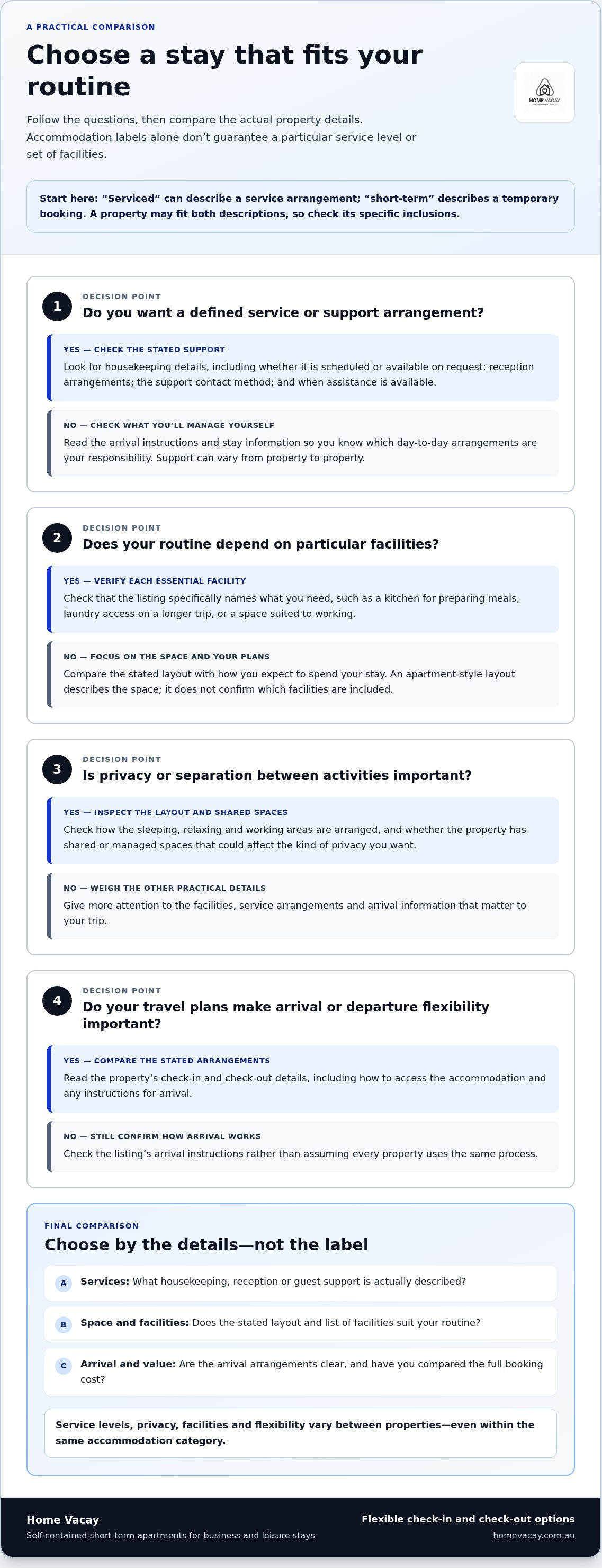
How to Choose the Right Stay for Your Trip
Start with the way you’ll spend your time, not the accommodation label. Work through these five points, then compare the options against your actual plans.
- Trip purpose: For work, consider your schedule, rest and how independently you want to manage your time. For a leisure break, decide whether you’d prefer defined services or the freedom to set your own pace.
- Length of stay: The longer you’re away, the more your everyday routine matters. Privacy, practical facilities and the effort involved in managing the stay can become more significant over time.
- Group needs: Consider who’s travelling and how everyone will use the space. Families may place more importance on privacy and room to settle in, while solo travellers may prioritise a simple routine.
- Service expectations: Decide how much support you want during your stay. Compare the services described for each property rather than assuming they come with a particular accommodation type.
- Essential facilities: List the features that will make your trip easier, such as facilities for preparing meals or a suitable place to work. Check that these are included in the property details.
Match the accommodation to your travel routine
For work trips, weigh the value of a steady routine against the independence to organise your own time. For family travel, focus on how the space supports everyone’s everyday needs and privacy. On a leisure break, consider whether service convenience or the freedom to make your own plans will help you relax. There’s no single right answer. Choose the stay that makes your days away comfortable and manageable.
Compare the booking details before deciding
Once you’ve narrowed down the stay type, compare the complete booking terms. Review the stated inclusions, arrival instructions, support information, cancellation terms and guest responsibilities. These details affect how the stay works in practice, especially if you arrive late or have a tightly planned itinerary. Make sure the arrangements suit your plans before booking.
A simple side-by-side comparison can help. Note what’s included, what you’ll need to organise yourself and which facilities matter to your group. Then compare the total booking cost for the same dates, including any stated fees. This helps you assess value without paying for services you’re unlikely to use or overlooking something that would make the stay easier.
Home Vacay offers self-contained short-term accommodation for business and leisure travellers, with flexible check-in and check-out options. If an independent routine suits your plans, explore Home Vacay’s short-term apartments.
A Self-Contained Short-Term Stay with Home Vacay
After weighing the pros and cons of serviced apartments vs short term rentals, you may find that an independent apartment stay suits the way you want to travel. Home Vacay offers short-term, self-contained apartment stays for business and leisure travellers. This format provides a base for your plans without assuming that every guest wants the same level of service or daily routine.
A self-contained stay can suit guests who prefer to organise their time independently. You might be travelling for work and want a place to return to between commitments, or travelling for leisure and prefer to set your own pace. Consider the information for each apartment to see whether the stay fits your needs.
What an independent apartment stay can offer
An apartment-style stay gives you a base for the practical parts of a trip as well as time to unwind. Independence is a preference, not a promise that every stay works in precisely the same way. Before booking, think about what your days will involve and which details matter to you. This helps you choose a stay that feels comfortable rather than paying for arrangements you don’t need.
For business travel, consider how you’ll move between planned commitments and downtime. For a leisure trip, think about the pace you’d like and the needs of everyone travelling with you. Use the property information to judge whether a particular stay fits.
Plan a stay that feels straightforward
Start with your travel dates, who’s coming and the routine you’d like to keep. Then compare the information for each stay with those practical needs. Flexible check-in and check-out options can accommodate different travel plans. You can book directly through the Home Vacay website and explore the available apartment stays.
- Dates: Choose the travel period that fits your plans.
- Group needs: Consider who is travelling and what will help everyone settle in.
- Daily routine: Think about how you’ll use your time during the stay.
- Stay information: Read the details provided for the apartment you’re considering.
- Arrival and departure: Factor flexible check-in and check-out options into your travel arrangements.
A little planning can make the accommodation choice simpler. Match the stay to your trip rather than trying to fit your plans around a label. If a self-contained apartment sounds like a comfortable base for your time away, explore Home Vacay stays.
Choose a Stay That Fits the Way You Travel
The best accommodation choice is the one that makes your time away easier. Before booking, picture an ordinary day of your trip: what would help you start well, settle in comfortably and move between plans without fuss? This brings the pros and cons of serviced apartments vs short term rentals into focus, because the right balance of service and independence is personal.
Home Vacay offers short-term apartment stays for business and leisure travellers. You can book directly and use flexible check-in and check-out options when planning your trip.
Explore Home Vacay stays and choose an apartment option that suits your plans. A little time spent comparing the practical details can help you feel settled and ready to enjoy your stay.
Frequently Asked Questions
Are serviced apartments the same as short-term rentals?
No, although a stay can fit both descriptions. “Serviced apartment” refers to apartment-style accommodation and its service arrangements, while “short-term rental” describes a temporary booking. A serviced apartment can be booked for a short visit, but a short-term rental doesn’t automatically include apartment services. To weigh the pros and cons of serviced apartments vs short term rentals, compare the details of the specific stay, especially if you have a particular routine in mind.
What is usually included in a serviced apartment?
There isn’t one standard set of inclusions. A property might describe housekeeping, guest support or other services, while another may focus on the apartment itself. If you’re arriving late or planning a longer visit, pay close attention to the arrival information and any service schedule. The booking terms and facilities list can help you work out what you’ll need to arrange yourself, such as meals or day-to-day upkeep.
Can a short-term rental be self-contained?
Yes, some short-term rentals are self-contained, but the term alone doesn’t guarantee specific facilities. If you plan to prepare breakfast or do laundry during a longer visit, look for those features in the property information. Consider how you’ll use the space each day, then compare the stated facilities with that routine. This helps avoid choosing a stay based on assumptions about what “self-contained” means.
Which is better for a family: a serviced apartment or a short-term rental?
Either could suit a family, depending on the property and what makes the trip comfortable. Think about how the group will use the space at different times, such as getting ready in the morning or winding down after a day out. Then compare the listed layout, facilities and service arrangements with those needs. A family’s preferred routine is a better guide than assuming one accommodation label is always more suitable.
Are serviced apartments better for business travel?
They can be a good fit if the stated services support your work routine, but they aren’t automatically the better choice. Consider whether you need a place to prepare for the day, take a break between commitments or work during downtime. A short-term rental may also work if its facilities and arrival arrangements suit your schedule. Compare the practical details with the way you expect to use the accommodation.
How much does a serviced apartment cost compared with a short-term rental?
There’s no fixed cost difference that applies to every booking. The total depends on the property, travel dates and booking terms, so compare the full amount for the same dates rather than relying only on a nightly rate. Also consider whether the inclusions suit your needs. A cheaper option may not be better value if you need facilities or services that aren’t part of the stay.
Is housekeeping always included in a serviced apartment?
No, housekeeping isn’t guaranteed by the serviced-apartment label. Arrangements may differ in whether cleaning is provided and how often. For a longer booking, consider how you’d like the space maintained and whether the stated schedule suits you. Read the property information so you can plan with a clear understanding of the housekeeping arrangements rather than relying on the name.


