

The cheapest nightly rate can become the most expensive stay once every charge is added. The hidden costs of short term rentals matter when guests compare places and when owners work out whether a property is paying its way.
A nightly price is only one part of the picture. Guests may also see cleaning or platform fees, taxes, or charges that apply in certain circumstances. Owners face a different set of costs, from regular upkeep and utilities to per-booking cleaning and occasional repairs. Keeping these two perspectives separate makes the final figures easier to understand.
This guide explains the main operating costs short-term rental owners may need to plan for and the charges guests may encounter during booking. You’ll learn how to compare the full cost of a stay across properties and lengths of stay, rather than relying on the advertised nightly rate alone. Include self-contained apartments in your comparison, whether you’re travelling for work or taking a break.
Key Takeaways
- Separate owner operating expenses from guest booking charges. They affect different people and shouldn’t be counted as the same cost.
- Group rental expenses by when they arise: recurring, per booking or occasional. This makes upkeep and replacements easier to account for.
- Use the hidden costs of short term rentals as a prompt to look beyond the advertised nightly rate and review the disclosed charges in the booking total.
- Compare accommodation options using the total for your dates, guest numbers and length of stay, not the nightly rate alone.
- For each cost, identify who pays it, when it applies, whether it can vary and where it appears in the booking details.
Hidden costs of short term rentals: understand whose costs you are counting
A cost can be hidden simply because it sits outside the headline figure. For a guest, that figure is often the nightly rate. For an owner, it may be the booking revenue before expenses are taken into account. In either case, a single number won’t show the full picture.
Start by separating the two sides. Guests pay the charges attached to their booking. Owners absorb the costs of preparing, maintaining and operating a rental. These categories can overlap in subject, but not necessarily in who pays. An owner’s cleaning bill, for example, doesn’t automatically mean a separate cleaning fee is charged to each guest.
A booking price shows what a guest pays for a stay; an owner’s operating costs show what it takes to provide that stay. This distinction matters when weighing up the hidden costs of short term rentals. General information about short-term rentals can provide useful context, but costs and booking arrangements depend on the individual property and platform.
What counts as a hidden cost for a rental owner?
Owner expenses tend to fall into three groups: recurring costs, booking-related costs and occasional costs. Utilities and routine upkeep may continue between stays. Cleaning, linen changes and restocking consumables can arise with each booking. Repairs or replacing worn furnishings are less predictable, but still part of the property’s operating costs.
Time counts, too. An owner who handles guest messages, organises cleaning, coordinates access and resolves small issues may not receive an invoice for those hours. That work still takes time away from other responsibilities. A rental can appear profitable on gross booking revenue while the owner’s time and expenses tell a more complete story.
Which costs can matter to a guest?
Focus on charges shown during booking, any conditional charges described in the listing, and the final total for your selected dates and guest numbers. The presentation and types of fees can differ by property and platform. Don’t assume a charge applies everywhere, or that an owner’s operating expense will appear as a separate line item.
A disclosed charge is visible in the listing or booking details before you commit. An unexpected or unclear charge is one you didn’t understand from the information presented. Before booking, review:
- Whether the displayed price is per night or for the full stay.
- Which additional charges appear in the booking breakdown.
- Whether any stated charge depends on how the property is used.
- The final amount shown for your dates, group size and length of stay.
This separation prevents a common mix-up: an owner’s cost of running a property isn’t automatically a guest fee. Keep owner expenses on one side and booking charges on the other, then use the guest-facing total to understand what the stay will cost you.
Short-term rental operating costs: follow the money from booking to upkeep
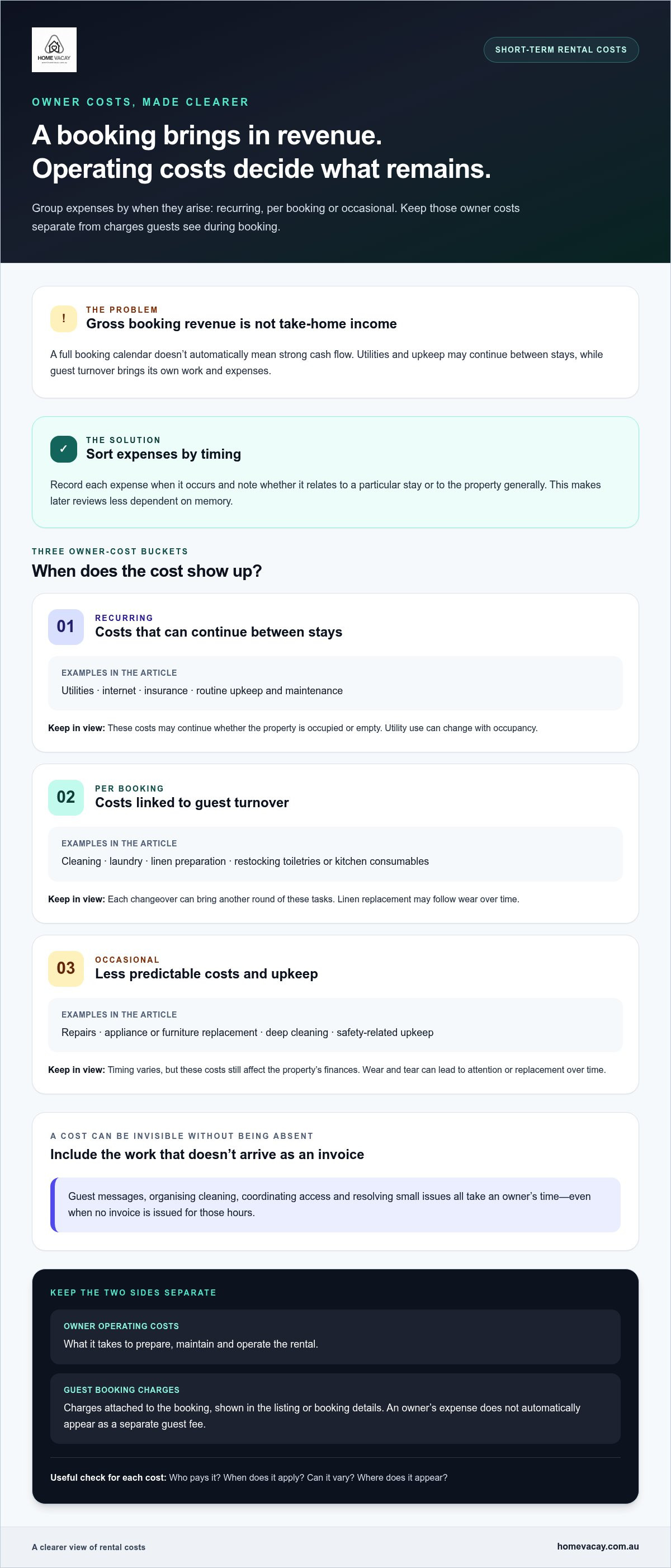
A booking brings in revenue, but hosting involves expenses before arrival and after departure. Grouping costs by timing helps owners see what continues over time, what each stay triggers and what may arise occasionally. It also explains why a full booking calendar doesn’t automatically translate into strong cash flow.
Booking revenue is the money coming in, not the amount an owner keeps after operating costs. To build a clearer picture, sort expenses into three practical groups:
- Recurring: Utilities, internet, insurance and routine upkeep may continue whether the property is occupied or empty.
- Per booking: Cleaning, laundry, linen preparation and restocking items such as toiletries or kitchen consumables are linked to guest turnover.
- Occasional: Repairs, appliance or furniture replacement, deep cleaning and safety-related upkeep can be less predictable but still affect the property’s finances.
These groups can help an owner notice patterns. Electricity use may change with occupancy, while linen replacement may follow wear over time. Record each expense when it occurs and note whether it relates to a particular stay or to the property generally. This makes it easier to review costs later, rather than relying on memory to assess how the property is performing.
Recurring costs and costs triggered by each stay
Some expenses are part of keeping a property ready to host. Utilities, internet, insurance and routine maintenance may continue between bookings. Each changeover can bring another round of cleaning, laundry and restocking. The exact mix depends on the property and how it’s run. An owner’s cleaning or laundry expense doesn’t determine whether a guest sees a separate charge for it. That depends on the booking terms.
Other costs depend on how the rental is managed. An owner may pay platform or payment processing fees, use paid management support, or organise tasks personally. Insurance arrangements also differ. Keep these in the owner’s records, but don’t assume they all appear as separate guest charges. Tracking each item separately helps show what the property earns and what it takes to operate.
Occasional costs, property wear and owner time
Guest turnover can bring work between stays, from checking supplies to arranging a repair after something wears out. Furniture, fixtures and appliances may need attention or replacement over time. Deep cleaning and safety-related upkeep can also arise. Because the timing varies, setting aside funds for irregular expenses can help owners avoid treating every strong booking period as money available to spend.
Self-management has a time cost, even without an invoice. For example, an owner might spend 20 hours across guest messages, coordinating cleaning, preparing access and following up on tasks. That’s an illustration, not a typical time estimate. Recording hours alongside paid expenses gives a fuller view of the work involved and helps compare self-management with paid support.
As a traveller, include a self-contained apartment alongside other accommodation options and compare the booking details for your trip. Home Vacay offers stays for business and leisure travellers. Explore self-contained apartments as part of your accommodation search.
Short-term rental costs compared: nightly rate, booking total and length of stay
A nightly rate is a useful starting point, but it can’t show the complete cost of a trip on its own. Compare the final displayed total for the same dates and guest count, then consider the length of stay. This keeps the comparison focused on what you would pay, rather than an advertised rate that may not reflect the full booking.
Compare accommodation using the full booking total
Use the booking summary to note the nightly rate, each disclosed charge, the total and the trip length. The example below uses placeholders only. It doesn’t suggest that any particular fee applies to every booking.
Illustrative comparison
Booking detail: Nightly rate | Disclosed fees | Stay total | Trip length
Short stay: A$[nightly rate] | A$[fees shown, if any] | A$[displayed total] | [number of nights]
Longer stay: A$[nightly rate] | A$[fees shown, if any] | A$[displayed total] | [number of nights]
For a fair comparison, enter the same dates, number of guests and trip length for each option. Include a cleaning fee, service fee or other charge only if it’s shown for that booking. Fee names, included items and price presentation can differ between properties and booking channels, so compare the actual breakdown instead of assuming two listings use the same structure.
Keep the guest-facing total separate from the owner’s figures. The guest total describes the amount presented for the stay. Owner net revenue is what remains after applicable booking deductions, while operating expenses cover the costs of running and maintaining the property. Those owner figures help assess rental finances, but they aren’t a substitute for the price shown to a guest.
Why length of stay changes the cost comparison
A fixed charge can have a different effect depending on how many nights you book. If the same disclosed charge applies to a shorter or longer stay, it makes up a larger share of the cost per night for the shorter booking. Spread across more nights, the charge may have less influence on the nightly average. The final total still matters most: don’t judge value from the average alone if the stays differ in other ways.
To work out an effective nightly comparison, divide the displayed stay total by the number of nights. Then check that both options suit the same travel dates, guest count and practical needs. A self-contained apartment can be included alongside other accommodation types, but no one option is always cheaper. The result depends on the specific booking and what its total covers.
Looking beyond the advertised rate helps make the hidden costs of short term rentals easier to assess. Compare like with like, use the total for the full stay, and leave owner expenses out of the guest price calculation.
Before booking a short-term rental, check these cost details
A careful booking review helps you see what the displayed price covers before you commit. Check the listing, booking summary and final total together. The hidden costs of short term rentals are easier to spot when you confirm the details for your exact trip, rather than relying on a headline rate or an earlier search result.
- Enter your travel details. Check the dates, guest numbers and length of stay. A change to any of these can change the displayed total or the charges that apply.
- Read what the listing says is included. Look for details about utilities, meals, linen and cleaning. Don’t assume these are included or excluded unless the listing explains them.
- Review each disclosed charge. Note any cleaning, service, linen or other fee shown for this booking. Don’t assume a charge applies if it isn’t disclosed in the details you’re reviewing.
- Separate required charges from choices. Identify charges that form part of booking the stay, optional extras you can choose, and conditional charges that apply only in stated circumstances.
- Read the applicable terms. Check cancellation conditions, deposit arrangements and damage terms as presented for the property and booking. These can vary, and a deposit or additional charge doesn’t apply to every rental.
- Check the final amount before confirming. Make sure the total reflects your dates, guest count and stay length, and that you understand any charges included in it.
If a charge or condition is unclear, review the booking information and terms before proceeding. A disclosed charge is easier to assess when you know what it covers, when it applies and whether it’s optional.
For another option to include in your comparison, explore self-contained apartment stays for business or leisure travel.
Read the listing and booking summary carefully
Read the listing alongside the booking summary, not as a substitute for it. A property description may outline facilities or inclusions, while the summary shows charges for your selected booking. Look for cleaning, service, linen or other fees where they’re disclosed. Inclusions can vary, so don’t assume utilities, meals or daily housekeeping are part of every short-term rental.
Check cancellation terms, deposits and possible extra charges
Before confirming, read the cancellation policy and any terms about deposits or damage. Check what triggers a conditional charge, how it’s described and whether it appears in the total or in separate booking terms. Timing and conditions differ between properties and bookings. Keep a copy of the details shown at confirmation so you can refer back to what applied to your stay.
Make a clearer short-term rental decision with the full cost in view
A confident decision starts with keeping two perspectives separate. Guests need to know the cost of their stay. Owners need to understand what remains from booking revenue after operating expenses and the time spent running the property. One figure can’t answer both questions.
A simple framework for weighing the full cost
For each cost, consider four things: who pays it, when it applies, whether it can vary and where it’s disclosed. This makes it easier to distinguish a guest charge from an owner expense, and a fixed amount from a cost that depends on the booking or property.
- Payer: Is the expense paid by the guest, the owner or another party?
- Timing: Does it recur, arise with each stay or occur occasionally?
- Variability: Is the amount consistent, or can it change with usage, occupancy or circumstances?
- Disclosure: For a guest charge, where is it shown in the listing or booking details?
Guests can use this framework to compare the final booking total for matching dates, guest numbers and stay lengths. Owners can use it to separate booking revenue from platform or operating deductions, ongoing property costs and their own management time. Don’t add owner expenses to a guest’s total unless they’re actually shown as a charge for that booking.
This distinction is at the heart of understanding the hidden costs of short term rentals. The right comparison isn’t just about finding one appealing figure. It’s about knowing what that figure represents, who is responsible for each cost and whether it reflects the whole stay or only part of the financial picture.
When an apartment stay may suit your plans
Accommodation should also fit the way you’ll travel. A self-contained apartment may suit a business traveller who wants a comfortable base between work commitments, or a family looking for a home-like setup during a leisure trip. Think about the space and facilities your plans call for, then compare the booking total with other options for the same dates and group size.
Home Vacay offers self-contained apartments for business and leisure stays, with flexible check-in and check-out options. Consider these details alongside the full cost when deciding what works for your trip. The best choice is the one that suits your needs and makes sense at the price shown for your booking.
Once you’ve weighed the total against your plans, take a look at Explore Home Vacay apartments.
Plan a stay that fits your priorities
Looking beyond the headline rate can help you make room for what matters on your trip, whether that’s a convenient base for work or a comfortable place to unwind. The hidden costs of short term rentals are easier to manage when your accommodation choice fits both your plans and the amount you’re comfortable spending.
As you decide, consider more than the price alone. Think about the space you’ll use, how you’ll spend your days and the ease you want around arrival and departure. A self-contained apartment may suit a business trip or leisure break, with a home-like setting for your time away.
Home Vacay offers direct website bookings and flexible check-in and check-out options. Review the available apartment details and decide whether a stay fits your plans.
Explore Home Vacay apartments for your next stay and find an option that suits your trip.
Frequently Asked Questions
What are the hidden costs of a short-term rental?
They’re costs that aren’t clear from the nightly rate or headline booking revenue. For guests, this could mean a disclosed booking charge that appears separately from the accommodation rate. For owners, it may include less visible expenses such as replacing a worn appliance or time spent arranging a repair. The same item can affect each side differently, so identify who pays it before including it in your comparison.
Are cleaning fees always included in a short-term rental booking?
No. A cleaning fee may be included in the displayed total, listed separately or not charged as a separate guest fee. Check the booking breakdown for your selected dates rather than relying on the listing’s nightly rate. If cleaning is described as included, that doesn’t necessarily mean every related service, such as daily housekeeping, is provided. The listing and booking terms explain what applies to that stay.
Can a short-term rental charge a security deposit?
A property or booking platform may require a deposit, but arrangements differ and a deposit doesn’t apply to every stay. Review the booking terms for the amount, when it’s due, how it’s held and the conditions for its return. Also distinguish a refundable deposit from a non-refundable fee. If the wording is unclear, review the relevant booking terms before confirming, and keep them for your records.
What happens if a guest cancels a short-term rental booking?
The refund or cancellation cost depends on the policy attached to that booking. Check the deadline for cancelling, whether the policy changes as the arrival date approaches and how any refund is calculated. For example, cancelling well before arrival may be treated differently from cancelling close to check-in. Save the confirmation and cancellation terms so you can refer to the exact conditions that applied when you booked.
Are utilities included in short-term rental accommodation?
It depends on the property and its booking terms. Some stays include utilities in the accommodation price, while other arrangements may describe separate or usage-based charges. Look for specific wording about electricity, water, heating, cooling and internet, particularly if you’ll be staying for an extended period or expect higher usage. Don’t infer what’s included from the type of accommodation alone; use the details provided for that listing.
Can guests be charged for damage after a short-term rental stay?
A host may seek payment for damage under the applicable booking terms, but the process and conditions vary. Before arrival, note any instructions for reporting an existing issue, then take dated photos if you find damage. If a charge is raised after departure, review the explanation and any supporting records through the booking channel. Keep messages and photos together, and follow the process stated in the booking terms if you disagree with the claim.
How can I compare the total cost of a short-term rental with a hotel?
Compare both options for the same dates, number of guests and number of nights. Use the full amount shown before booking, then add any extras you expect to choose, such as meals or parking, only where they’re relevant and priced. Compare what each option provides for your plans, including space and facilities. A rental or hotel isn’t automatically better value; the right choice depends on your trip and the final totals.


