

A serviced apartment isn’t the only way to settle in for an extended stay. Monthly furnished apartment rentals in Australia offer a ready-to-live-in base, from compact apartments to larger homes. Some short-stay apartments include hotel services such as room service, while a private furnished stay can suit travellers who prefer a more independent setup.
Look beyond the word “serviced” when comparing options. The right fit depends on the space you need, the services you value and how you’ll access the property. Booking terms and key collection vary, so understand the process before choosing dates. A suitable setup can make an extended work trip or family visit easier from the day you arrive.
This guide explains furnished options for longer stays, how property size can shape your choice, and what to expect when booking and collecting the keys. It also covers flexible arrival and departure dates, helping you plan around work, family commitments or a longer visit.
Key Takeaways
- Decide whether you need hotel-style services or the independence of a private furnished apartment before comparing stays.
- For holidays or major events, arrange accommodation in advance.
- Match the property type and space to who’s travelling and how you’ll use the apartment during your stay.
- Understand the booking steps and key collection arrangements so arrival feels straightforward.
- Set out your preferred move-in and move-out dates early, and consider how date flexibility could shape your options.
Looking for serviced apartments?
Serviced apartments may combine furnished accommodation with hotel services such as room service. Compare the services, booking terms and arrival arrangements before choosing.
Booking Around Holidays and Events
If you’re travelling during a holiday period or major event, book accommodation in advance. Busy periods can reduce the choice of locations and property types. Start by setting your dates and identifying where you need to be. Then compare access to public transport, major roads, workplaces, services, amenities and shopping. Staying near an event may shorten travel, while another location could work better for daily routines.
Websites Listing Monthly Rentals
In Australia, listings appear on short-stay platforms, accommodation operators’ websites and property-rental websites. Search using your destination, dates and preferred stay length. Read each listing closely: confirm that the apartment is furnished, note the stated services, and understand the booking and key collection process. Compare the full terms, not just the headline description. A monthly listing should match your intended dates and needs.
Arrangements differ between furnished apartments. A listing may include room service or regular cleaning, while a private short-stay apartment may not offer hotel-style services. Don’t assume “serviced” means the same thing everywhere. Read the included-services description and booking conditions before paying. If you need room service, for example, look for it explicitly in the listing.
If you’re an international traveller, start by identifying the Australian state or territory where you’ll stay. The legal status of furnished accommodation depends on the arrangement and how the property is used, not just its furnishings. Residential tenancy rules differ across states and territories. Read the agreement carefully and check whether it describes a residential tenancy or short-stay accommodation. That distinction helps clarify which terms govern your stay.
Good booking support means clear information about the reservation, arrival and key collection. Before confirming, send one message with your arrival time, guest numbers and access questions. Save the written reply with your booking details. If plans change, follow the platform or operator’s stated process and refer to the cancellation and change terms. Written records help both parties follow the agreed arrangements.
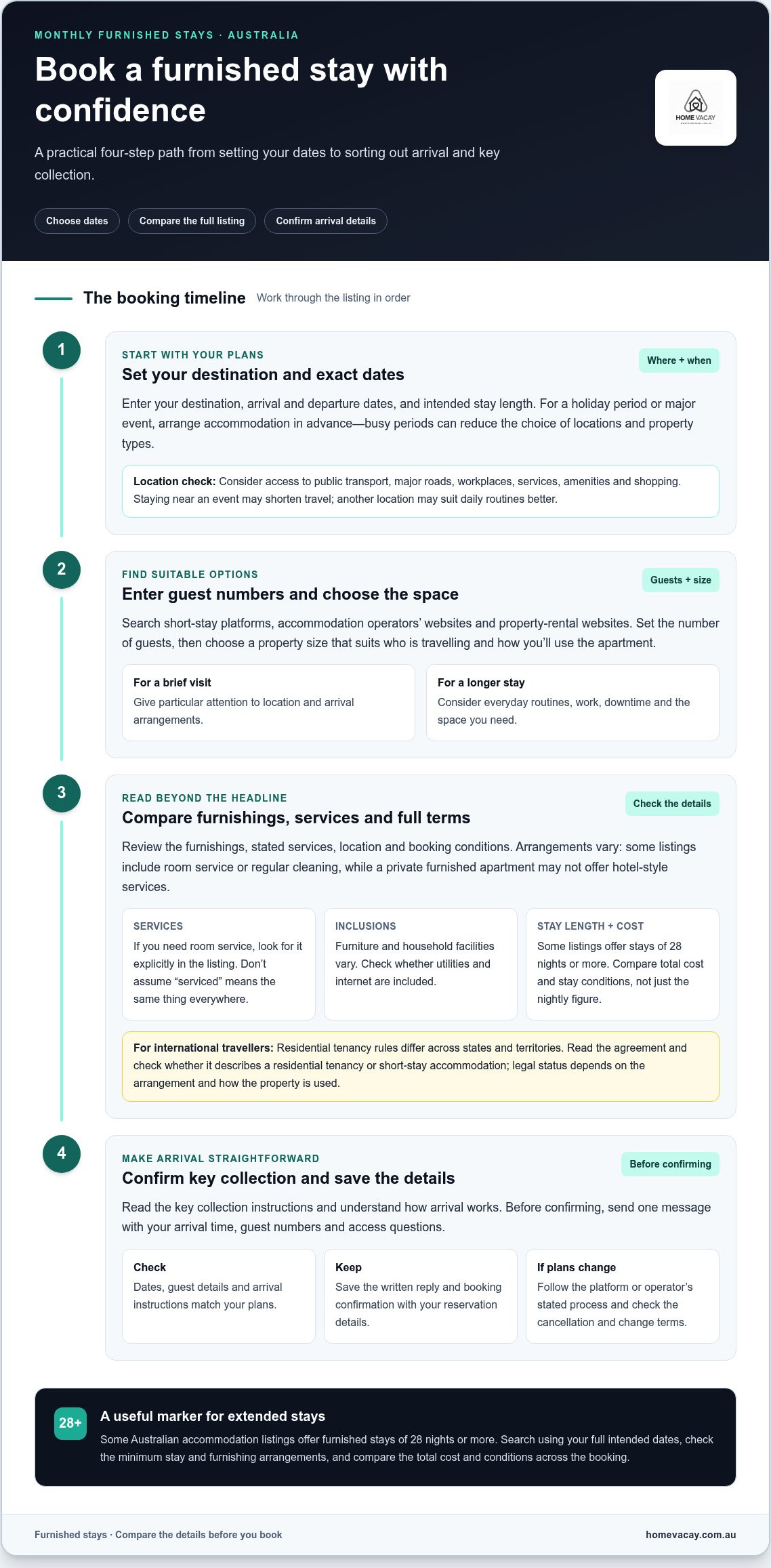
Online booking is easier when you work through the listing in order:
- Enter the destination and exact arrival and departure dates.
- Set the number of guests and choose a property size that suits them.
- Review the furnishings, services, location and full booking conditions.
- Read the key collection instructions and save the confirmation.
For a holiday or major event, book early. Before finalising, confirm that the dates, guest details and arrival instructions match your plans.
Check access to public transport, major roads, workplaces, services, amenities and shopping.
Furnished apartments for extended stays
Furnished accommodation can suit a holiday, temporary work placement or longer visit. Compare the stay length, inclusions and booking terms to find a practical fit.
Temporary and Extended Stay Options
Temporary accommodation can cover a short work trip, holiday or gap between homes. A furnished apartment gives you somewhere to stay without arranging furniture for a temporary move. For a brief visit, focus on location and arrival arrangements. For a longer stay, consider how the space will work for everyday routines, work and downtime.
Stays of a Month or Longer
Some Australian accommodation listings offer furnished stays of 28 nights or more. That suits travellers whose plans extend beyond a short holiday, including people on work placements or visiting family. Search using your full intended dates and read the length-of-stay terms. Furnished short-stay apartments can be ready to live in, making it easier to settle in without organising household basics.
Longer bookings can affect the nightly rate, so compare the total cost and stay conditions rather than relying on the nightly figure alone. The length of your visit, property type and booking terms all shape value. Check how the rate is calculated across your dates before reserving.
Support During an Extended Stay
For a longer booking, keep your reservation details and accommodation contact method together. If an issue arises, send a clear message through the booking channel, including your stay dates, apartment details and a description of the problem. This gives the person handling your enquiry the context to respond. For practical needs such as laundry or fresh linen, check the property information.
Finding Monthly Furnished Rentals
Search accommodation platforms, operators’ websites and short-stay listings for monthly furnished apartment rentals in Australia. Enter your destination and dates, then look for listings that state the minimum stay and furnishing arrangements. A nightly listing may not suit a month-long visit, so compare its terms with your intended dates. Save a shortlist to compare location and inclusions side by side.
Furniture and household inclusions vary by property. Read the listing to see which furnishings and facilities are described rather than assuming every apartment has the same setup. Check the listing or booking terms for whether utilities and internet are included. Treat them as separate comparison points, especially for a work stay that depends on internet access.
Customer accounts can add a practical perspective alongside the listing terms. One customer testimonial describes a six-week business trip in Sydney, while a customer testimonial says an apartment problem was resolved with a replacement within 24 hours. These examples illustrate details a traveller may want to assess: whether accommodation suits the intended length of stay and how a concern is handled. They are individual experiences, so check the property information and booking conditions directly, and keep the accommodation contact method available throughout the visit.
Apartment sizes and property types
Choose a property based on who’s travelling and how you’ll use the space. Furnished options include monthly furnished apartment rentals and private houses, each suited to different routines. A business guest working from the apartment may value a separate living area. A family might prioritise room to relax together and enough sleeping space. Start with your daily needs, then compare layouts.
Short-term private houses and apartments are usually fully furnished and ready to live in. This can reduce the work of arranging furniture for a temporary stay. But “furnished” doesn’t describe every detail. Check each listing for the furniture, kitchen facilities and other household items provided. Compare those details with your daily needs, such as a desk for work or dining space for shared meals.
Consider how everyone will share the property. A family testimonial describes a five-week stay in a rental apartment suitable for four adults, showing why guest capacity and sleeping arrangements matter for longer visits. Check the stated capacity and bedroom setup, then consider whether the shared living areas suit your group. A suitable guest limit doesn’t automatically mean the layout fits everyone’s routines.
Property type also shapes the feel of an extended stay. An apartment may put you closer to urban services and work destinations, while a private house may suit travellers who want more separation between shared and personal spaces. Treat these as comparison points, not promises about a particular listing. Consider the location, floor plan and property description together. A business booking near a workplace may have different priorities from a family holiday.
Use this checklist when comparing monthly furnished apartment rentals across different destinations:
- Match the stated guest capacity to everyone travelling.
- Review bedrooms and sleeping arrangements for your group.
- Look for living and dining areas that suit daily routines.
- Compare furnishings and facilities with your work or family needs.
- Check the property location against your regular destinations.
For a business trip, consider how the apartment supports work between appointments. A customer account describes a six-week business trip, illustrating through Home Vacay bookings why the everyday layout matters during an extended stay. Look for a practical place to work and room to unwind. For a family, consider shared space and sleeping arrangements before decorative details.
Compare properties using the same criteria each time: guest capacity, layout, furnishings, location and stated facilities. This makes differences easier to spot, whether you’re weighing an apartment against a private house or comparing two monthly furnished apartment rentals. A property that fits your group and daily routine can make an extended stay feel more settled.
Enquiry, reservation and key collection process
A clear booking process takes you from enquiry to confirmation, payment and arrival. Keep your reservation details and key instructions together throughout the stay.
Bond, Deposit and Upfront Fees
There’s no single upfront amount for every furnished stay. The booking terms should state any bond, deposit or fees, when payment is due and how the amount is handled. Read these details before paying. Check, for example, whether a deposit is separate from the accommodation charge and which conditions apply to its return. Keep the agreement and payment record with your reservation.
Inspections and Scam Avoidance
Before booking, compare the listing’s photos, address, amenities and written description. If you can’t inspect in person, ask for a live video walkthrough. Check that the person handling your enquiry can explain the apartment and booking terms clearly. Keep communication and payment within the platform’s stated process. Avoid paying to an account that doesn’t match the named booking party, and save receipts and messages.
A useful enquiry gives the accommodation provider enough detail to respond clearly. Include your arrival and departure dates, guest numbers and reason for travel. Add practical questions, such as whether there’s a suitable work area or how key collection works. A friendly, specific exchange can clarify the arrangements before you reserve.
Before confirming, compare the written terms with the listing. Check the dates, total charges, cancellation conditions, included facilities and arrival instructions. If the confirmation differs from the original listing, resolve the difference in writing before paying. This gives you a clear record of what you booked, whether you’re travelling for work or arranging a family holiday.
After your reservation is confirmed, save the booking reference and payment receipt. Read the key collection instructions before travelling, including where to collect the keys and what to do on arrival. If access uses a lockbox or another method, make sure you understand the instructions and can access them offline. Keep key details somewhere easy to find.
Use this simple sequence to keep the process organised:
- Send your dates, guest numbers and essential questions.
- Review the agreement, charges and cancellation terms.
- Complete the reservation through the stated booking process.
- Save the confirmation, receipt and key collection instructions.
For a remote booking, ask for current images or a live walkthrough showing the entrance and main rooms. Compare what you see with the listing before paying. Keep the provider’s replies with your booking documents. These steps can help you spot mismatched details and arrive with the right access information.
Flexible move-in and move-out dates
Plans for an extended stay can shift around work, family commitments or travel connections. Set your ideal dates and understand how changes affect the booking before you commit.
Start with the dates you can rely on. A work placement, for example, may have a fixed start date but an uncertain finish. A family visit may depend on school or event plans. Write down your earliest arrival, preferred departure and any dates that could change. Use these details to compare accommodation terms.
Some furnished apartment stays are offered for 28 nights or more. If your plans may run shorter or longer, compare the minimum stay with your expected schedule. A booking built around the wrong period can create an awkward gap or require an extension. Choose a starting length that reflects the trip, rather than assuming you can adjust it later.
Before reserving, read the terms for changing arrival or departure dates. Look for the stated process, any notice period and whether a date change affects the total booking cost. Conditions vary by reservation. Save the terms with your confirmation so you can refer to them if your plans change.
Consider how arrival and departure times fit your travel day. A late flight, a connection through Sydney or a work meeting on departure day can affect when you need access. Check the key collection and check-out instructions alongside your dates. If travel times are uncertain, mention that in your enquiry before confirming.
If an extension looks likely, contact the accommodation provider through the booking channel as soon as your plans firm up. State your current departure date and the additional dates you need. This keeps the request clear and tied to your reservation. If you need to leave earlier, follow the change or cancellation terms rather than relying on a verbal understanding.
Use this planning sequence before booking in Australia:
- Set your preferred arrival and departure dates.
- Mark any work, family or travel commitments that could shift.
- Compare the minimum stay with your expected length.
- Read the booking terms for date changes and extensions.
- Save the confirmation and access instructions together.
For a longer visit, date flexibility is useful only when the booking terms allow the change. Keep your plans and the written reservation aligned. Browse furnished accommodation options as you plan your stay dates.
Home Vacay: Capitol Apartments in Canberra City
Home Vacay offers Capitol Apartments in Canberra City for business and leisure travellers seeking a furnished stay in the capital. For a family trip, Peaceful Coombs Apartment for Families is another Canberra option. Luxury Apartment in Braddon Precinct offers a further choice in Canberra’s Braddon area.
Compare each property’s location and details with your travel plans, guest needs and preferred dates. These furnished apartments may suit a temporary visit rather than a residential tenancy or a hotel stay with daily housekeeping. Choose the option that best matches your reason for travelling and preferred location.
Explore Home Vacay’s properties or discuss your accommodation plans by visiting homevacay.com.au.
Make your next stay feel settled
Start by deciding what matters most for this particular stay. A work visit may call for a comfortable base for downtime, while a family trip may need a layout that suits shared routines. Separate essential features from those that would simply be welcome. This gives your search a clear direction.
Choosing monthly furnished apartment rentals is easier when you picture an ordinary day, not just your arrival. Think about where you’ll start the morning, spend time between plans and unwind at night. This simple test can help you decide whether a property suits how you’ll use it.
When you’re ready to explore a Canberra stay, contact Home Vacay about your stay. Share your plans and preferred dates to begin the conversation.
A little clarity can make the next step easier. Take your time to find a place that suits your visit.
Frequently Asked Questions
What is the average monthly rent for a furnished apartment in major Australian cities?
There’s no useful average for every Australian city or apartment type. Monthly costs depend on location, apartment size, travel dates, guest numbers and booking length. A central property during a major event may cost differently from a home in a quieter area. Compare listings for the same dates and guest count, then assess the total stay cost and included facilities instead of relying on a broad city average.
What are the minimum stay and lease terms for monthly furnished rentals?
Minimum stays and booking terms vary by property. Some accommodation listings offer furnished stays of 28 nights or more, while other listings set different booking periods. Before reserving, read the stated minimum stay, payment schedule, cancellation conditions and date-change process. Also distinguish a short-stay accommodation booking from a residential tenancy agreement. The type of agreement and its terms matter more than the apartment being furnished.
How do furnished apartment prices compare with hotels and serviced apartments for a month?
Compare the full cost for matching dates, guest numbers and accommodation needs. A hotel or serviced apartment may include services such as regular cleaning or room service, while a private apartment can offer a more independent stay. Those inclusions affect value as well as price. In Melbourne, serviced apartment rates usually decrease for longer stays. Check the total booking terms and included services before deciding which option suits your month.


