

A family holiday works better when the accommodation fits the way you travel. Finding child-friendly holiday apartments means looking beyond the photos: choose a place with sleeping space, kitchen facilities and storage to suit your family, along with practical features for your children’s ages. A separate living area can also give adults room to unwind once the kids are asleep.
It’s easy to focus first on location or a sunny balcony. But day-to-day details matter too, from preparing a simple meal to finding space for bags, toys and prams. The right apartment can make family routines easier to manage while giving everyone room to settle in.
This guide explains how to compare apartments by age suitability, kitchen facilities, space, storage, sound separation and children’s clubs. You’ll also learn what to look for in child-friendly listings, including safe play areas and layouts that make supervision easier. Use these points to narrow your options and find a comfortable stay for the whole family.
Key Takeaways
- Match the apartment’s layout and nearby play options to your children’s ages and daily routines.
- Assess whether the kitchen has the facilities and supplies your family needs to prepare meals comfortably.
- Choose sleeping arrangements that give everyone enough space, with practical storage and separation between living and sleeping areas.
- Compare children’s clubs by age suitability and the activities they offer, so they fit your family’s plans.
- Look for child-conscious details such as clear sightlines to play areas, washable finishes and non-slip materials.
Filtering accommodation by children’s ages
Start with each child’s age, then match the apartment’s layout, access and nearby activities to your family’s routine. A toddler’s needs differ from those of a school-age child.
Compared with a family hotel or resort in Australia, an apartment usually gives families a kitchen and separate living space, while hotels may offer on-site services and activities. Compare what matters for your trip, including meal preparation, sleeping arrangements and children’s facilities.
Australian families can search Stayz, Airbnb and Booking.com using family-friendly accommodation filters. Filter by guest numbers and property features, then read the listing details to see whether the apartment suits your children’s ages.
Before booking, ask the host about stairs or lift access, balcony safety, sleeping arrangements and nearby play areas. For a toddler, also ask about a cot or high chair and how far away the closest playground is.
Age-based accommodation filters
Use the children’s ages as a practical shortlist, not just the guest count. For a toddler, consider lift access, safe balcony design and room to manage a pram. For school-age children, look for nearby play areas and enough space for quiet activities. A playground 20 minutes away may be inconvenient for a short family outing.
Family-friendly booking filters
On Stayz, Airbnb and Booking.com, start with filters for family stays, guest numbers and the facilities your group needs. Then check photos and descriptions for details the filters may not capture, such as stairs, balcony access or the distance to a playground. Save suitable options and compare their layouts before deciding.
Compare the total accommodation cost for the same travel dates and number of guests. Include the full stay, cleaning charges and any other listed fees rather than judging by the nightly rate alone. A larger apartment may cost more per night but offer separate bedrooms and a kitchen, which could better suit your family’s plans.
School-holiday dates can affect availability and the type of stay that suits you. On Hamilton Island, summer school holidays fall in December to January, Easter break in March to April, and the winter escape period in June to August. Match your dates to your children’s routine, then compare suitable apartments for the same period.
Garden access and sea views can make a listing appealing, but assess how each feature works for your children. Look for an enclosed garden or courtyard where play is easier to supervise. For a sea-view apartment, check whether the balcony has secure barriers and whether adults can see children playing from the living space.
Use a final shortlist to compare practical details side by side: age suitability, access, play space, total cost and sleeping arrangements. A third-floor apartment without a lift may feel tiring when carrying shopping and a toddler. A four-lane road outside may also make a nearby park less convenient to reach on foot.
Self-catering facilities and kitchen supplies
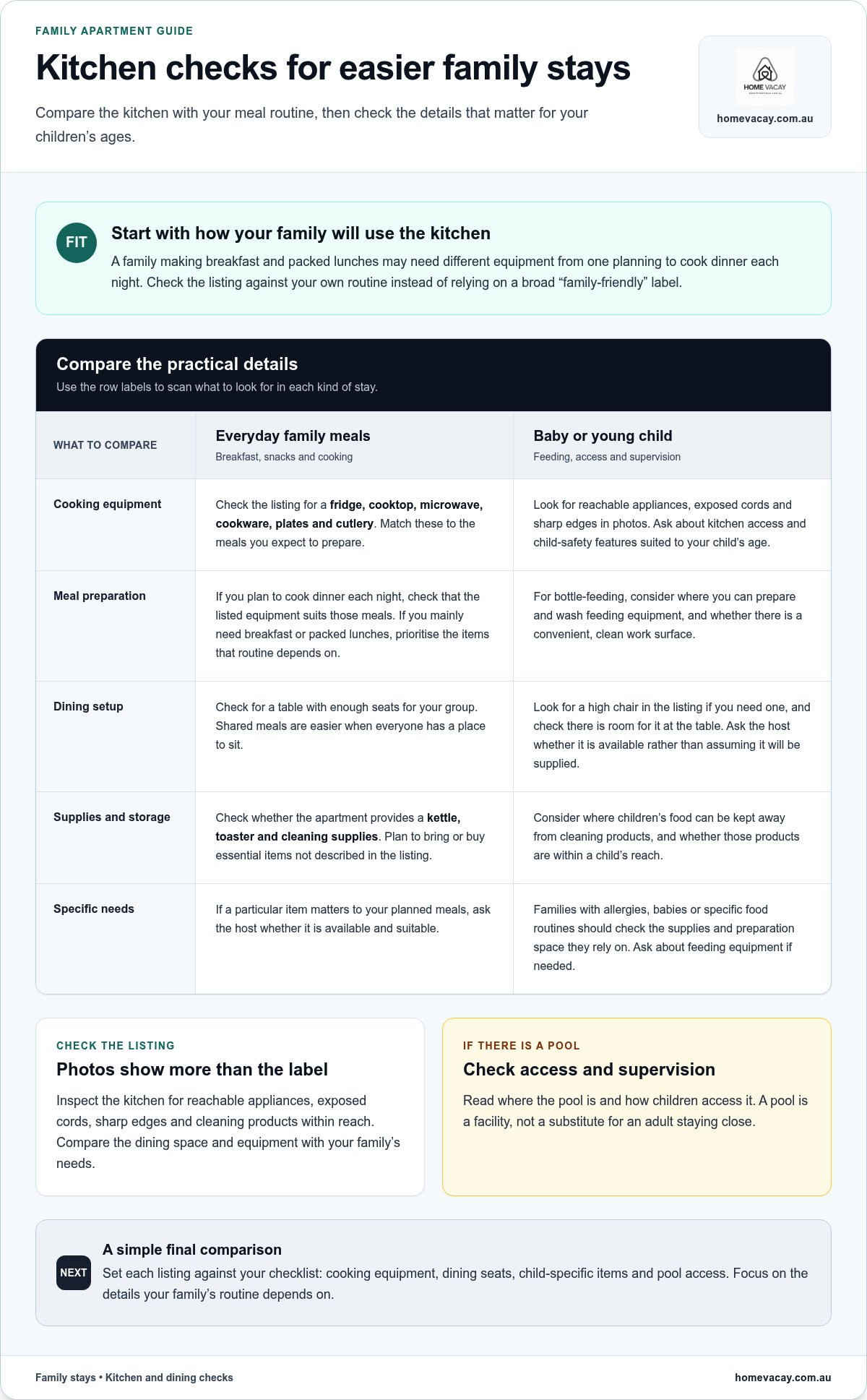
A practical kitchen can make family meals and snacks easier during a stay. Compare the cooking equipment, dining setup and child-focused facilities with your family’s routines.
A child-friendly apartment gives families useful cooking and dining facilities alongside features suited to children’s needs. For babies and young children, assess kitchen access, dining arrangements and everyday hazards, such as reachable hot surfaces or sharp utensils.
Start with the meals you expect to prepare. A family making breakfast and packed lunches needs different equipment from one planning to cook dinner each night. Look for a fridge, cooktop, microwave, cookware, plates and cutlery in the listing. If a particular item matters, ask the host whether it’s available and suitable for your planned meals.
Next, consider how the kitchen connects with the dining area. A table with enough seats for your group makes shared meals easier than balancing plates on a coffee table. Families with a young child can look for a high chair in the listing. If you need one, ask whether it’s available rather than assuming it will be supplied.
Kitchen supplies matter particularly for families with allergies, babies or specific food routines. Check whether the apartment provides a kettle, toaster and cleaning supplies. Plan to bring or buy essential items not described in the listing. For bottle-feeding, consider where you’ll prepare and wash feeding equipment and whether there’s a convenient, clean work surface.
To assess the space for babies and young children, inspect photos for reachable appliances, exposed cords, sharp edges and cleaning products within reach. Ask about kitchen access and child-safety features suited to your child’s age. For a pool, look at its location, how children access it and what supervision the space requires. A pool is a facility, not a substitute for an adult staying close.
Dining and recreation facilities also shape a family’s day. Look for enough seating, space for a portable high chair and a suitable place to keep children’s food away from cleaning products. If a pool matters, read the listing details about its location and access. Consider whether other facilities will keep the stay comfortable if your family spends time indoors.
Compare each listing against your family’s needs rather than relying on broad labels. For example, a family preparing breakfast in the apartment may value a toaster and table more than a large selection of cookware. A family with a baby may place more importance on a clear preparation area and suitable feeding equipment.
Before booking, make a short checklist: cooking equipment, dining seats, child-specific items and pool access. Compare listings against it, particularly if your family relies on a particular meal routine or facility. This makes practical differences easier to spot and helps you plan what to pack.
Apartment size, storage and soundproofing
Compare the floor plan with your family’s sleeping and daytime routines. A listing’s guest capacity doesn’t show whether everyone has a comfortable bed, room for luggage or space to settle without disturbing others. Look for a suitable bedroom layout, storage and separation between shared areas and sleeping spaces.
A family with two children commonly looks for a holiday apartment for four people with two bedrooms. That arrangement can give parents and children separate sleeping spaces. Check the listing’s bed configuration, not just its total guest capacity. A sofa bed in the living room may change how the family uses that room once bedtime begins.
For six people to sleep separately, one example is two double rooms and one room with two single beds. This arrangement uses three bedrooms. Compare it with your group’s needs, including whether children can share a room and whether adults need separate beds. A clear floor plan can help you see how beds, doors and shared spaces fit together.
Storage deserves a place on your shortlist. Families need adequate storage inside the apartment or somewhere easily accessible. Look for wardrobes, drawers and a clear spot for bags, shoes and children’s belongings. For example, a family travelling with a pram can consider whether it will fit near the entry without blocking the path to a bedroom or bathroom.
Sound separation affects how comfortably a family can use the apartment. Acoustic separation or soundproofing between units can help prevent noise from children disturbing neighbours. Read the listing details for clues about the layout, then consider where children will play and sleep. A living area separated from bedrooms can make quiet time easier to manage.
Think through a simple evening routine. If the youngest child goes to bed at 7 pm, parents may be able to use the living room afterwards. That works best when the sleeping area is separate and ordinary conversation or television doesn’t carry directly into the bedroom. Check the floor plan to see whether the living room shares a wall or doorway with children’s beds.
A balcony can add usable outdoor space, but its layout matters. In some apartments, it may be the only private outdoor space children can use, making safety an important consideration. Check whether the balcony opens directly from a bedroom or living area and whether adults can supervise children from inside. Treat it as part of the apartment’s usable space, not automatically as a play area.
Before booking, compare the floor plan with your family’s belongings and routines. Picture where beds, luggage, a pram and play items will go. Then check that storage, sleeping space and sound separation work together, rather than relying on the advertised guest count alone.
Children’s clubs and age suitability
A children’s club can add structured activities to a family stay, but it won’t suit every child or itinerary. Compare its age groups, activities and session arrangements with your children’s interests before treating it as a deciding feature.
Start by reading the club’s age guidance. A programme designed for independent school-age children may not suit a toddler who needs close parental support. Look for clear information about eligible ages, whether children are grouped by age or activity, and what happens if siblings fall into different groups.
Check the activity descriptions, not just the word “club”. For example, craft sessions, outdoor games and quiet indoor activities suit different interests and energy levels. A child who prefers familiar routines may enjoy a short, hands-on activity more than a full schedule of group games. Match the programme to your child rather than assuming every advertised activity will appeal.
Check where the club operates in relation to the apartment. A programme in the same resort or building can fit differently into the day than one requiring a separate trip. Map the route from the accommodation to the club entrance, and consider how you’ll manage drop-off, collection and other family plans. This is particularly useful when younger children need an adult nearby.
Look for published details on session times, booking arrangements and adult supervision. These details help you understand whether the club fits a planned outing or leaves enough time for meals and rest. If the listing mentions a club but provides little practical information, don’t build the whole day around it. Treat it as one possible activity, alongside family plans that don’t depend on organised sessions.
- Age fit: Compare the stated age groups with each child’s needs and confidence.
- Activity fit: Look for examples that match your children’s interests.
- Location: Consider the route between the apartment and the club.
- Routine: Compare session times with meals, rest and outings.
For apartments without an on-site club, plan activities nearby instead. A nearby enclosed courtyard or play space may give children room to move while adults remain close. Consider how the apartment’s living area supports downtime between outings, especially if siblings enjoy different activities.
Keep the club in perspective when comparing stays. A well-matched programme can give children a chance to meet others and try an activity, while the apartment provides a base for family time. Choose accommodation that works for your group even when no club session is planned. That way, the stay doesn’t depend on one facility to keep every child occupied.
Vetted child-friendly apartment listings
No single Australian destination suits every family. Canberra, Bundeena and Noosaville offer different trip settings, so choose based on planned activities, travel distances and the apartment features your children need. The best fit is the destination that makes your family’s daily plans practical.
Booking risks include misleading photos, missing details and payment requests outside a booking platform. Parents can reduce these risks by comparing the listing description with its photos, reading recent guest feedback and keeping booking messages and payments on the platform. Avoid transferring money through an unexpected link or separate payment request.
Vetting starts with evidence in the listing. Read every description, inspect each room photo and compare the stated facilities with what appears in the images. A photo of a play space, for example, doesn’t show whether parents can supervise it from inside the apartment. Look for a floor plan or room views that show how the spaces relate.
Check the route between indoor living areas and outdoor play areas. Clear sightlines between these spaces can make parental supervision easier. If photos show a courtyard, see whether an adult can view it from the kitchen or living room. A layout that blocks the view may not suit your family’s play routine.
Look for practical, child-conscious finishes. Apartments for families should use durable components, such as washable finishes, and safe components, such as non-slip and non-toxic materials. Listing photos can show flooring and surfaces, but they may not reveal how materials perform in daily use. Treat specific descriptions as useful evidence when comparing two otherwise similar options.
Use a repeatable listing check before booking:
- Match the details: Compare the listed beds, rooms and facilities with the photos.
- Assess play areas: Look for clear sightlines from indoor spaces to outdoor areas.
- Review finishes: Note descriptions of washable surfaces and non-slip materials.
- Keep records: Save the listing and booking messages on the platform.
For example, if a listing describes an enclosed courtyard, check the photos for its access points and the view from shared rooms. If the images don’t show those details, compare other listings with clearer layouts. This gives parents a consistent way to judge family suitability instead of relying on labels such as “family-friendly”.
Build a shortlist around the features that matter most to your family, then compare the evidence across each listing. For an Australian family stay, explore family apartment options as one way to continue your search.
Canberra, Bundeena and Noosaville are destinations to consider, but the best choice depends on your family’s planned activities, travel distances and apartment needs. Compare individual listings for clear layouts, useful facilities and spaces that make supervising children easier.
Home Vacay: Capitol Apartments in Canberra City
Home Vacay offers Capitol Apartments as an option for families planning a holiday. Use the checks in this guide to compare the apartment with your children’s ages, preferred layout and travel plans.
For other options, consider Peaceful Family Apartment or Luxury Precinct Apartment. Each has a distinct location and name, giving you a starting point for weighing where you’d like to stay. Choose the option that best fits your family’s itinerary and accommodation priorities.
For a family holiday, explore Home Vacay’s listings and decide which apartment suits your plans. You’re welcome to visit homevacay.com.au.
Choose a stay that fits your family’s plans
Before you book, decide what would make the stay work best for your family. It might be a convenient base for outings, a comfortable place to spend a quiet day, or room for children to follow familiar routines. Keeping that priority in view can make finding child-friendly holiday apartments feel more focused.
For a Canberra stay, Home Vacay offers Capitol Apartments in Canberra City, Peaceful Coombs Apartment for Families, and Luxury Apartment in Braddon Precinct. Consider which option best fits your planned activities and preferred location, then explore the details at your own pace.
Your next step can be simple: take your shortlist and compare it with the way your family wants to spend the trip. If you’d like to explore a Home Vacay stay, contact Home Vacay about family stays. A little planning now can help you look forward to a more settled family break.
Frequently Asked Questions
Why a holiday apartment with kids?
A holiday apartment can give families more privacy and flexibility than a single hotel room. Finding child-friendly holiday apartments can help you choose a base where children follow familiar routines while adults have separate space to relax or plan the next day. For example, a family travelling with grandparents may value shared space for meals and conversation, alongside bedrooms where different members can turn in at different times.
What amenities should families look for in a holiday apartment with children?
Prioritise amenities that support your family’s daily routine and planned activities. Laundry facilities can help families travelling with young children manage clothing changes, while window coverings may help create a calmer sleep space. Consider whether the apartment has enough seating for shared downtime and a convenient place to dry wet swimwear after a beach or pool outing. These practical details can shape how comfortably the family settles in.
How much do child-friendly holiday apartments cost in popular Australian destinations?
Costs vary by destination, travel dates, apartment size and included facilities. School-holiday demand and the length of stay can also affect the total. When finding child-friendly holiday apartments, compare the full booking amount for your exact dates, including any cleaning or other listed charges, rather than relying on a headline nightly rate. A destination’s distance from planned activities may also shape your overall travel budget.


