

When deciding where to stay for a week, look beyond the photos and consider how your accommodation will fit around each day. A place that seems convenient at first may not support the routines that make a week away feel easy.
Location and price matter, but so do space, sleeping arrangements and the details you’ll rely on throughout the stay. The right base should suit your plans, whether you’re travelling for business, taking a family break or exploring at your own pace.
This guide shows you how to compare accommodation types and check the practical details before you book. Home Vacay offers short-term apartments for business and leisure stays, with options suited to families and work trips. Use your daily routine as a guide to choosing a place that feels settled from the first day to the last.
Key Takeaways
- Start with the purpose of your trip, then choose a base that suits your work, family time, sightseeing or mix of plans.
- When deciding where to stay in Canberra for a week, consider how the accommodation will support your everyday routine, not just its first impression.
- Use a comparison table to weigh up accommodation type, stated facilities, sleeping arrangements, arrival details and booking conditions.
- Plan your arrival and save key booking information so the first day feels more straightforward.
- Consider whether a short-term apartment offers the practical base you need for work or leisure.
Where to stay for a week: start with the shape of your trip
A week-long stay has different needs from an overnight visit. Daily routines have more time to shape your experience, so it helps to decide what you need before comparing accommodation. Whether the main purpose is work, family time, sightseeing or a mix, let that guide what feels practical.
Think about who’s travelling, what you’ll bring and how much time you expect to spend indoors. A solo traveller with a full work schedule may use their accommodation differently from a family with extra luggage and plans for quiet afternoons. A good week-long base supports your everyday plans, not just your arrival. For general background before planning an itinerary, read this overview of Australia’s capital city.
Match the accommodation to the reason for travelling
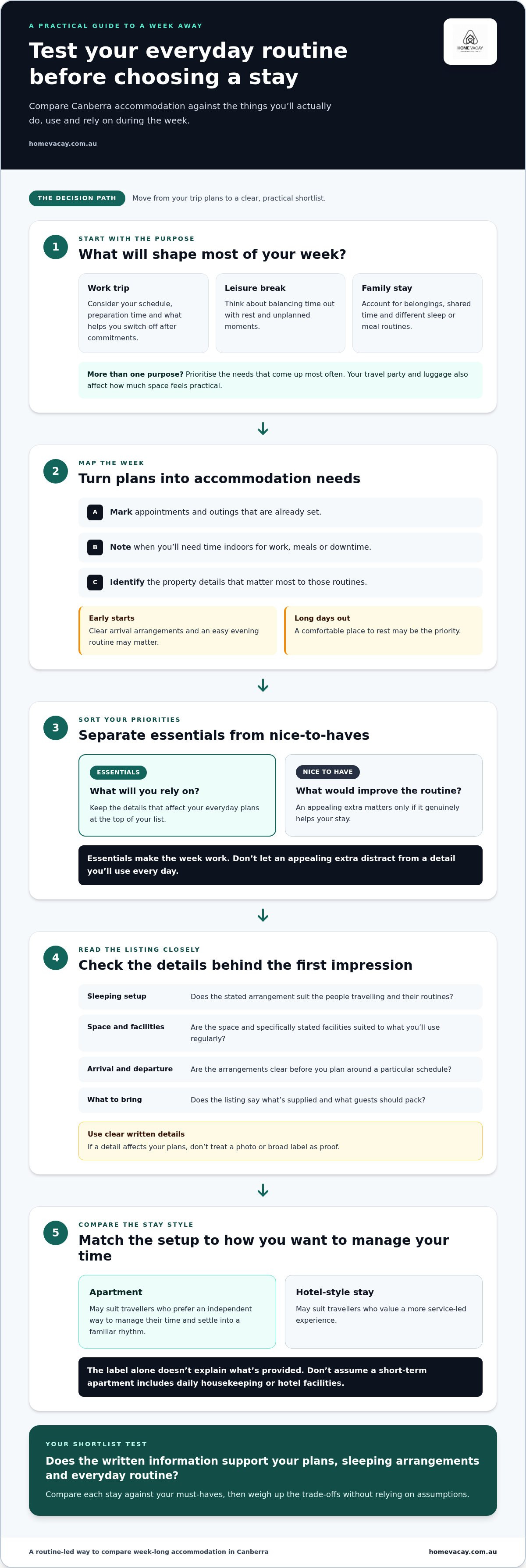
Start with the needs you’ll notice most often. For work, consider your schedule, preparation time and what helps you unwind after commitments. For leisure, think about where you’ll rest between outings and whether you want room to slow down or change plans. Families may need to consider shared space, different routines and where everyone’s belongings will go.
- Work trip: Consider your schedule, preparation time and what helps you switch off after commitments.
- Leisure break: Think about how you’ll balance time out with rest and unplanned moments.
- Family stay: Account for everyone’s belongings, shared time and any different sleep or meal routines.
If your trip has more than one purpose, prioritise the needs that come up most often. A few sightseeing days may matter less than daily work requirements, while a family holiday may call for room to regroup after outings. Your travel party and luggage matter too. A compact setup may suit one person but feel crowded when everyone is indoors together.
Map out the week before comparing stays
Write down fixed appointments, planned outings and the days you’re likely to spend more time at your accommodation. Then note everyday tasks such as meals, rest, work preparation and laundry. This outline turns a broad search into a shortlist based on the details that matter to your trip.
- Mark appointments and outings that are already set.
- Note when you’ll need time indoors, whether for work, meals or downtime.
- Use those routines to identify the property details that matter most.
For example, early starts may make clear arrival arrangements and an easy evening routine important. Several long days out could make a comfortable place to rest the priority. If you’ll be working, allow for time to prepare and reset between commitments. With the shape of your trip clear, you can compare stays against real needs rather than first impressions.
Choose week-long accommodation by testing your everyday routine
A listing can look appealing and still leave everyday questions unanswered. When deciding where to stay in Canberra for a week, read each option with your routine in mind. Self-contained accommodation gives guests an independent place to stay, rather than relying on hotel-style services for the basics. The setup varies, so use the listing’s stated details to understand what’s included.
Over several days, practical details can shape how comfortable a stay feels. You may want space to prepare for work, take a quiet break between outings or organise your belongings. Not every feature is essential. Look for clear information about the things you’ll actually use. For ideas to help plan your days, consult this official tourism guide, then consider how much time you’ll spend out and about.
Essentials make the week work; nice-to-have features matter only if they improve your routine. Separate the two before comparing listings. That way, an appealing extra won’t distract you from a detail that affects every day. It’s a practical way to assess where to stay in Canberra for a week based on what you’ll rely on, not just what catches your eye.
Decide whether an apartment or hotel-style stay suits you
An apartment may suit travellers who prefer an independent way to manage their time and settle into a familiar rhythm. A hotel-style stay may suit those who value a more service-led experience. The label alone doesn’t explain exactly what’s provided, so don’t assume a short-term apartment includes daily housekeeping or hotel facilities. Compare the stated arrangements with your preferences, and use a holiday apartment-versus-hotel comparison guide to weigh up the differences.
Check the details that shape a comfortable week
Read the listing with your travelling group in mind. Check how the sleeping arrangements are described, whether the space seems suited to everyone and which facilities are specifically stated. If a detail affects your plans, don’t treat a photo or broad label as proof. Clear written information is more useful than an appealing first impression.
- Sleeping setup: Match the stated arrangement to the people travelling and their routines.
- Space and facilities: Focus on what you’ll use regularly, rather than features you may not need.
- Arrival and departure: Review the stated arrangements before planning around a particular schedule.
- What to bring: Look for clear details about what’s supplied and what guests should pack.
A family might focus on whether the sleeping setup and shared space suit everyone, while a work traveller may prioritise a calm place to prepare for the next day. Keep a short list of must-haves and compare each listing against it. This makes trade-offs easier to spot and helps you avoid assumptions when deciding where to stay in Canberra for a week.
If an apartment suits your plans, explore Home Vacay’s short-term apartments for a work or leisure stay.
Compare accommodation listings with a week-stay checklist
Once you know what matters for your trip, compare each option using the same framework. A consistent checklist makes it easier to see whether a listing meets your needs, without letting polished photos or a catchy headline make the decision for you. It’s a useful way to decide where to stay in Canberra for a week while keeping practical details in view.
Compare stated listing details, not assumptions based on photos or broad labels. An official accommodation guide can help you explore different types of stays, while an individual listing provides details about a particular property.
Set up three columns: your need, evidence in the listing and follow-up notes. Add a row for each detail that could affect your week. If you need a sleeping arrangement that suits a family, record what the listing states and note anything it doesn’t explain. If a detail is essential but unclear, keep it on your follow-up list rather than assuming it’s included.
- Accommodation type: Note whether it’s an apartment, hotel or another type of stay, and whether it suits your trip.
- Facilities: Record only facilities the listing specifically states, especially those you expect to use regularly.
- Sleeping setup: Compare the stated arrangement with the people travelling and your preferred routines.
- Arrival details: Write down the check-in and check-out information shown for each option.
- Booking conditions: Note payment timing and cancellation terms so you can compare the practical commitments.
Read listing details beyond the headline and photos
Open the full description before shortlisting a place. Read the occupancy information and stated facilities, then compare those details across your options. Photos can help you understand the layout and feel of a space, but they don’t confirm that an amenity is provided. If it isn’t stated, don’t count it as part of the offer. A like-for-like comparison helps reveal which listing fits.
Keep essentials separate from preferences. A suitable sleeping setup may be non-negotiable, while a particular view may simply be appealing. This distinction keeps attractive images in perspective and makes trade-offs clearer. If an option looks promising but leaves a practical question unanswered, note the gap rather than filling it with an assumption.
Understand booking conditions before committing
Before booking, review the cancellation and payment terms, along with the check-in and check-out arrangements shown during the booking process. Keep the confirmation and arrival instructions together somewhere easy to access. This can save time when you need to check a detail on arrival day.
Use your notes to finish the comparison. Review your essential needs first, then weigh up preferences and any remaining questions. A short-stay apartment booking checklist can help you give the terms one final read before you commit. The aim is a clear choice, with the details that shape your week understood in advance.
Plan the practical details that make seven nights easier
A little preparation can make the first evening calmer and the rest of the stay easier to organise. Confirm the booking, plan your arrival, pack what you’ll need straight away and save key information somewhere easy to find. You don’t need to schedule every hour. A few practical steps leave room to settle in once you arrive.
- Confirm the booking. Save the dates, booking confirmation and arrival instructions. Check the stated check-in and check-out arrangements so your travel plans fit the booking.
- Plan your arrival. Use the information supplied with the booking to work out transport and timing. Allow some breathing space in case your journey takes longer than expected.
- Pack immediate essentials separately. Keep items you’ll want on the first evening easy to reach, rather than buried in your luggage.
- Save important details. Store the accommodation contact details and booking information somewhere accessible, including offline if that suits your travel plans.
This simple sequence can save you searching through bags or messages when you’re tired. It also gives you a clear starting point if plans shift before arrival.
Prepare for arrival and the first evening
Before setting off, check that you have the latest arrival instructions and know where to find them. Pack medication, chargers, a change of clothes and the essentials you rely on each day in a separate bag. Keep the first evening light. Once you arrive, unpack what you need, get comfortable and leave the rest for the next day.
Arrival arrangements can shape your timing. Home Vacay offers flexible check-in and check-out options, so you can plan around the arrangements for your booking. Keep the details with your travel information rather than relying on memory or a message you may struggle to find later.
Make the space work for work, family or downtime
Take a few minutes to settle your belongings and identify the facilities stated for your stay. Put frequently used items somewhere convenient. If you’re travelling with family, agree on a simple place for shared essentials. For a work trip, organise what you need for your next commitment. These small habits can make the space easier to use without turning unpacking into a project.
A light routine can also give the week some shape. Set a rough rhythm for meals, work preparation and downtime, while leaving room for plans to change. Avoid filling every day from morning to evening. A slower spell between commitments gives everyone time to rest, catch up or enjoy an unplanned activity. A short-stay apartment preparation guide can help you think through what to bring, but your own routine is the best starting point.
For a practical base during a work or leisure stay, explore Home Vacay’s short-term apartments.
Find a week-long apartment stay that feels easy to settle into
A good choice brings together the purpose of your trip, your daily routine and the booking details. Start with what you’ll be doing, then compare each stay against the needs that will come up during the week. Use the listing to check the sleeping setup, stated facilities and arrival information, and read the booking terms before deciding. That way, you’re choosing for how you’ll use the accommodation, not just how it looks.
A short-term apartment may suit travellers who value an independent place to return to between work commitments, family plans or outings. It can provide a base for settling into the week. It won’t be the right fit for everyone, though. If a service-led stay better matches your priorities, weigh that preference alongside the practical details. Let your needs lead the choice.
When a short-term apartment can suit a week away
An apartment stay may appeal if you want to organise your days around your own plans and have a place to pause between them. Consider how much time you expect to spend indoors and which listed facilities matter to your routine. Check the details rather than assuming particular amenities or services come with an apartment. The best fit is the one that meets your priorities.
For a work trip, that might mean a straightforward place to return to between commitments. For leisure, it could be a base that lets you balance time out with rest. Families may consider whether the stated sleeping arrangements and space suit the group. These needs vary, so compare each option on its own details rather than treating one type as universally better.
Take the next step with Home Vacay
Home Vacay offers short-term apartments for business and leisure travellers, with options suited to families and work trips. Guests can book directly through the Home Vacay website. Flexible check-in and check-out options can help with planning. Read the booking details as part of your final comparison so you understand how the stay fits your plans.
Before you decide, bring your shortlist back to four points: your reason for travelling, the routines you want to keep, the information in each listing and the booking terms. If an apartment lines up with those needs, take a look through Home Vacay’s short-term apartments on the website.
Choose a base that gives your week room to unfold
Before you book, picture the first morning of your stay. Think about what would help you begin the day comfortably and what kind of place you’ll be glad to return to after your plans. That simple picture can make the final choice clearer. Choose a base that fits the way you want the week to feel, not just the way it looks in a listing.
Home Vacay offers short-term apartments for business and leisure travellers, with options suited to families and work trips. You can book directly through the website, with flexible check-in and check-out options to help plan your stay. Review the available details and decide which option fits your plans.
Explore Home Vacay’s short-term apartments and find a comfortable base for the week ahead. A little time spent choosing well can help you arrive ready to settle in and enjoy the days as they come.
Frequently Asked Questions
Can an apartment work well for a week-long stay?
Yes, an apartment can suit a week-long stay if its layout and stated facilities fit your plans. It may be a good match if you want to settle between outings or keep a familiar rhythm during a work trip. Consider whether the space suits your group at quieter times, not only when everyone is heading out. The right fit depends on your routine and the details in the listing.
What should I look for when booking accommodation for a week?
Start with details that can affect comfort across the whole stay: guest capacity, sleeping arrangements, stated facilities, arrival process and booking terms. Consider whether the space will suit everyone at the same time, such as when the group is getting ready in the morning. Check the full booking details before committing, including any conditions attached to changes or cancellation, so you can choose what fits your plans.
Is an apartment or hotel better for a seven-night trip?
Neither is automatically better. An apartment may appeal if you prefer an independent stay and want a place to return to between plans. A hotel may suit you if its service style better matches your preferences. Compare the specific arrangements rather than relying on the accommodation label. Think about how much support you expect during the stay, how you’ll spend your time indoors and what the listing explicitly includes.
How far in advance should I book accommodation for a week away?
Book once your dates and main plans are reasonably settled, especially if you need a particular sleeping setup or are travelling with a group. There’s no single lead time that suits every trip, as choice can depend on dates, location and demand. If your plans are still taking shape, review cancellation conditions before booking. That gives you a clearer view of the flexibility available if dates change.
What should I check about check-in before booking a short stay?
Check the check-in and check-out times, how arrival access is arranged and where instructions will be provided. Consider your likely arrival time, including what you’ll do if your travel runs late. Keep the relevant booking details and accommodation contact information somewhere easy to find. Clear arrival instructions can help you plan the journey and avoid unanswered practical questions when you arrive.
Can I book a short-term apartment directly with Home Vacay?
Yes. Home Vacay guests can book short-term apartments directly through the website. Have your intended dates and guest details ready so you can review the options and booking information carefully. Check that the stay suits your plans and read the arrival and departure details. Home Vacay offers flexible check-in and check-out options, with arrangements relevant to each booking.
What should I pack for a week in short-term accommodation?
Pack for your plans and bring personal essentials you rely on each day, such as medication, chargers, toiletries and suitable clothing. If you’ll be working, include the equipment and documents you need. For a family, think about children’s familiar items and belongings that support their routine. Read the accommodation details before packing so you can distinguish what’s stated as supplied from what you’ll want to bring yourself.


